

In the Enuma Elish, the Babylonian creation account inscribed on clay tablets over three thousand years ago, the world does not begin in stillness. It begins in violence. The god Marduk defeats the primordial sea-mother Tiamat in single combat and splits her body in two, raising one half into the sky and setting the other as the ground beneath it.
Order, in this telling, is not opposed to chaos. It is carved directly out of it.
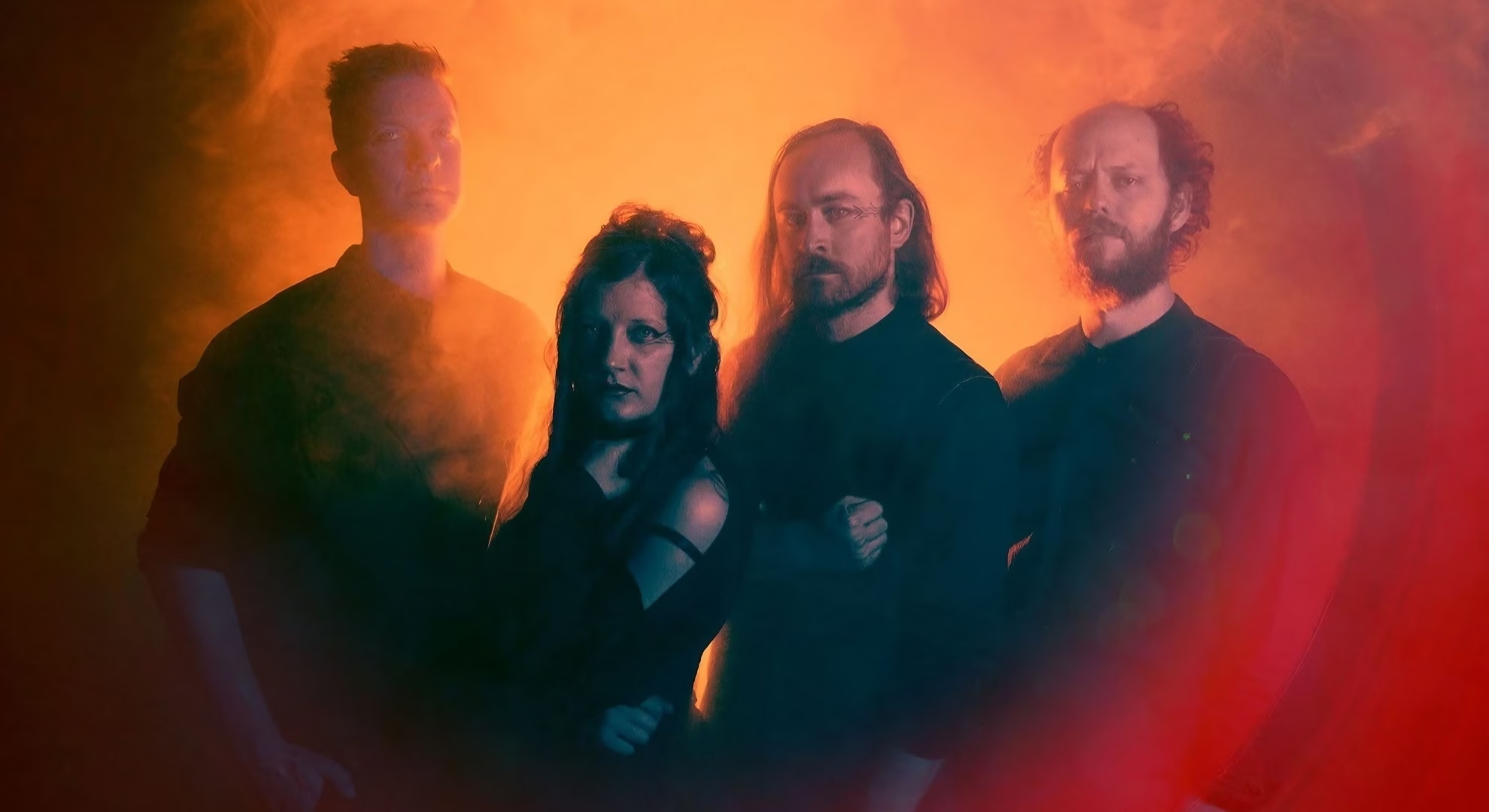
That structuring idea, a cosmos assembled out of a defeated body, returns in an unexpected register on the first track of a sixth studio album by a four-piece from the Denver metro area. Dreadnought open ‘Wars of Spirit // Wards of Light’ with a song called ‘Tiamat’s Gate,’ and the choice is not incidental. It signals how the record intends to work: creation and destruction treated as a single continuous motion rather than opposing forces.
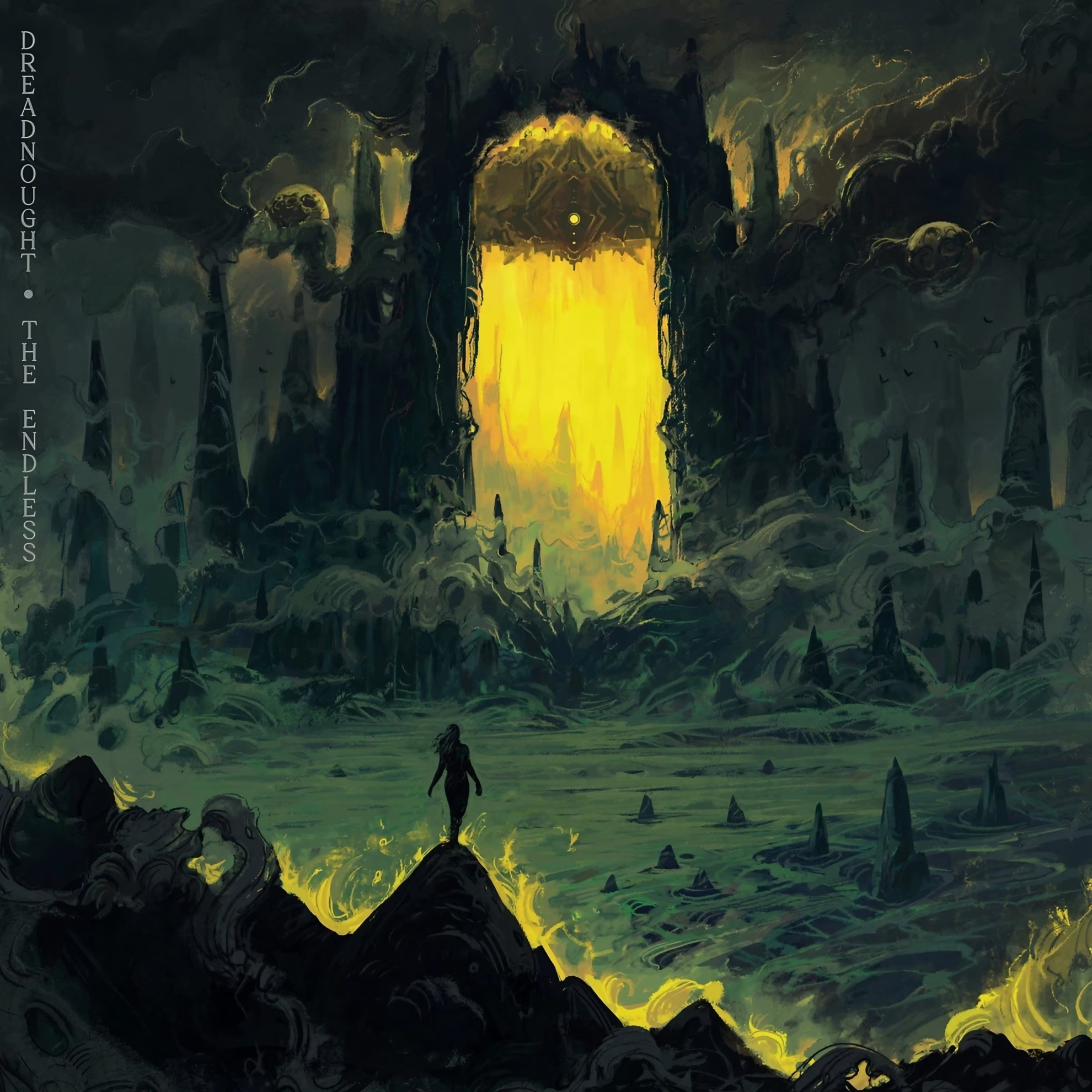
Dreadnought release ‘Wars of Spirit // Wards of Light’ on September 11th through Vesperian, an independent label founded earlier in 2026, with Metal Blade Records handling international physical and digital distribution. It follows 2022’s ‘The Endless,’ released through Profound Lore, and marks the first time in the band’s history that a European label has taken the lead on a release.
Physical pressings anchor the release: a digipak CD, a cassette in a violet shell, and vinyl pressed in black and in a blue-and-crimson tri-color nebula colorway, alongside a gold-and-blue split edition with red splatter limited to 400 copies and sold sold exclusively through Bandcamp and the Vesperian store.
Every vinyl edition includes a poster, a four-page booklet, and an OBI strip. Digital formats are available as well, positioned as a secondary route to a record designed, first, around its physical objects.
A Career Made of Refusal
Dreadnought’s discography begins with ‘Lifewoven’ in 2013, followed by ‘Bridging Realms’ in 2015, ‘A Wake in Sacred Waves’ in 2017, and ‘Emergence’ in 2019. Across those four records, the Denver, Colorado band earned a reputation for refusing the genre boundaries that structure most extreme metal criticism, moving between progressive metal’s harmonic ambition, black metal’s velocity, doom’s weight, and folk instrumentation without treating any of them as a home base, a pattern of genre hybridity that recurs across metal’s stylistic margins more than its commercial center.1
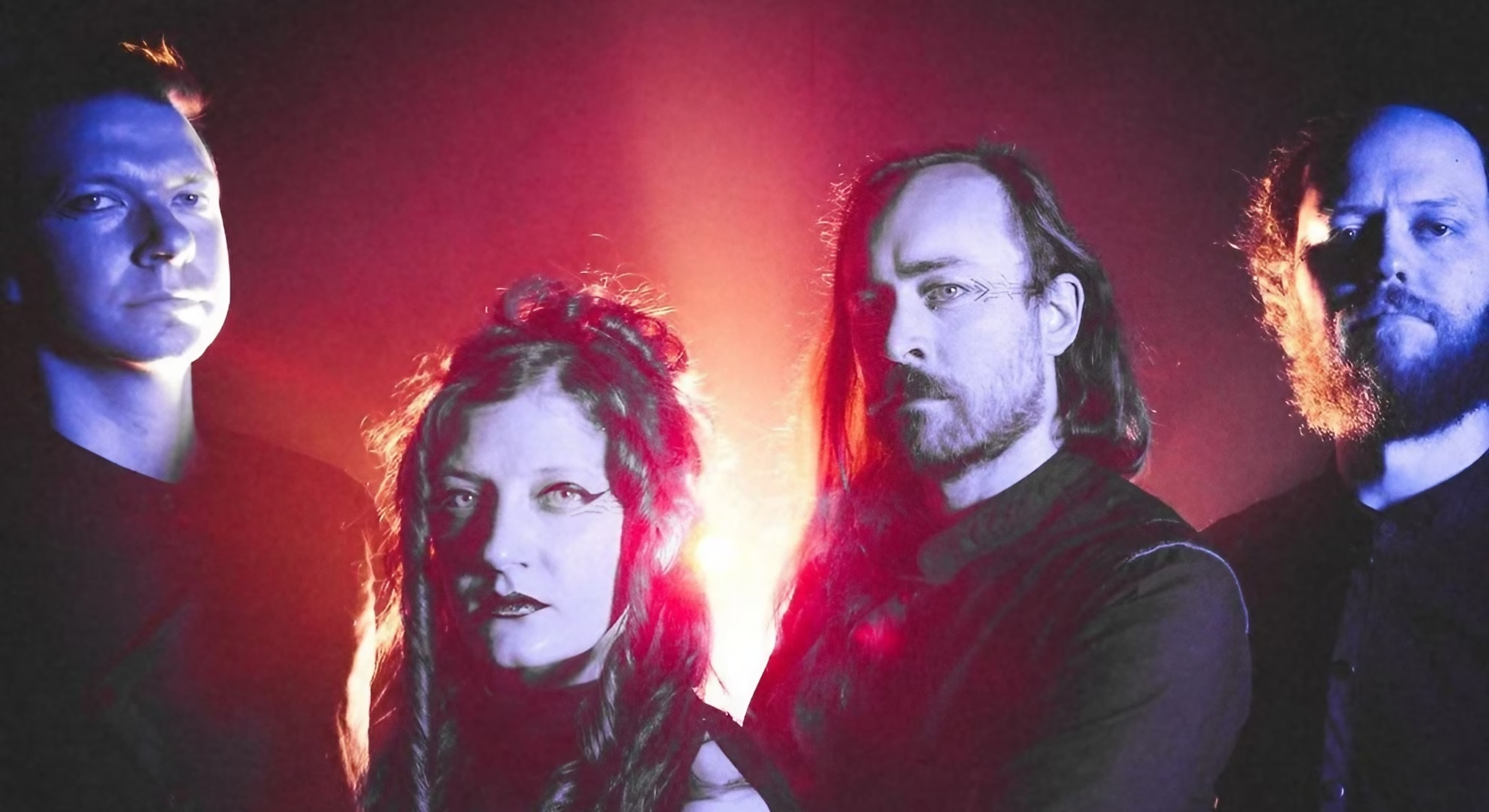
The band’s constant core, vocalist and guitarist Kelly Schilling, bassist Kevin Handlon, and drummer and percussionist Jordan Clancy, has anchored every release since ‘Lifewoven.’ The fourth chair has changed hands over the years: keyboardist Lauren Vieira held it on ‘Emergence,’ and guitarist and vocalist Ryan Sims occupies it on ‘Wars of Spirit // Wards of Light.’
The band’s reach beyond Colorado is documented rather than inferred. A 2019 tour in support of ‘Emergence’ carried the group from the Hi-Dive in Denver through Los Angeles, Chicago, Detroit, Boston, and Brooklyn, and this past summer brought them to the 2026 edition of Fire in the Mountains, held July 23rd through 26th at Red Eagle Campground on Blackfeet Nation land in Montana, on a bill that placed them alongside Norway’s Enslaved, Borknagar and Japan’s Sigh.
Where ‘The Endless’ Left Them
‘The Endless,’ released through Profound Lore Records in August of 2022, retained the melodic grandeur that had defined ‘Lifewoven’ and ‘Bridging Realms’ while carrying forward the darker complexity of ‘A Wake in Sacred Waves’ and ‘Emergence.’ Conceptually, the album turned toward the division between light and suffering in individual lives, and the choices that shape both a person and the wider world around them.
Where earlier Dreadnought records had often worked through more abstract or mythic material, ‘The Endless’ grounded its ideas in something closer to lived ethical weight.
That turn toward duality, light against suffering, order against what threatens it, did not end with ‘The Endless.’ It resurfaces explicitly in the title of the new record, though the emphasis has shifted. Where ‘The Endless’ asked what a person carries through difficulty, ‘Wars of Spirit // Wards of Light’ names the conflict outright and stages it as something closer to cosmology than confession.
Singles as a Map Forward
‘The Archive,’ released as a music video on July 20th, functions as the album’s opening statement and its most direct piece of songwriting. Running a little over four minutes, the track moves with an economy that departs from the sprawling, multi-part structures of ‘Emergence’ and ‘A Wake in Sacred Waves,’ trading duration for immediacy without abandoning the vocal interplay between Schilling and Sims that has defined the band’s harmonic identity.
‘Colors of Our Broken Hearts,’ issued a month later on August 20th, sits differently inside the record. Synthesizers and electronic texture move further to the foreground than on any prior Dreadnought release, a shift that aligns with the involvement of mixing engineer Julius Mauranen, whose work with the Finnish psychedelic black metal group Oranssi Pazuzu has made him one of the more recognizable names in a style that treats repetition and electronic texture as structural tools rather than ornamentation.
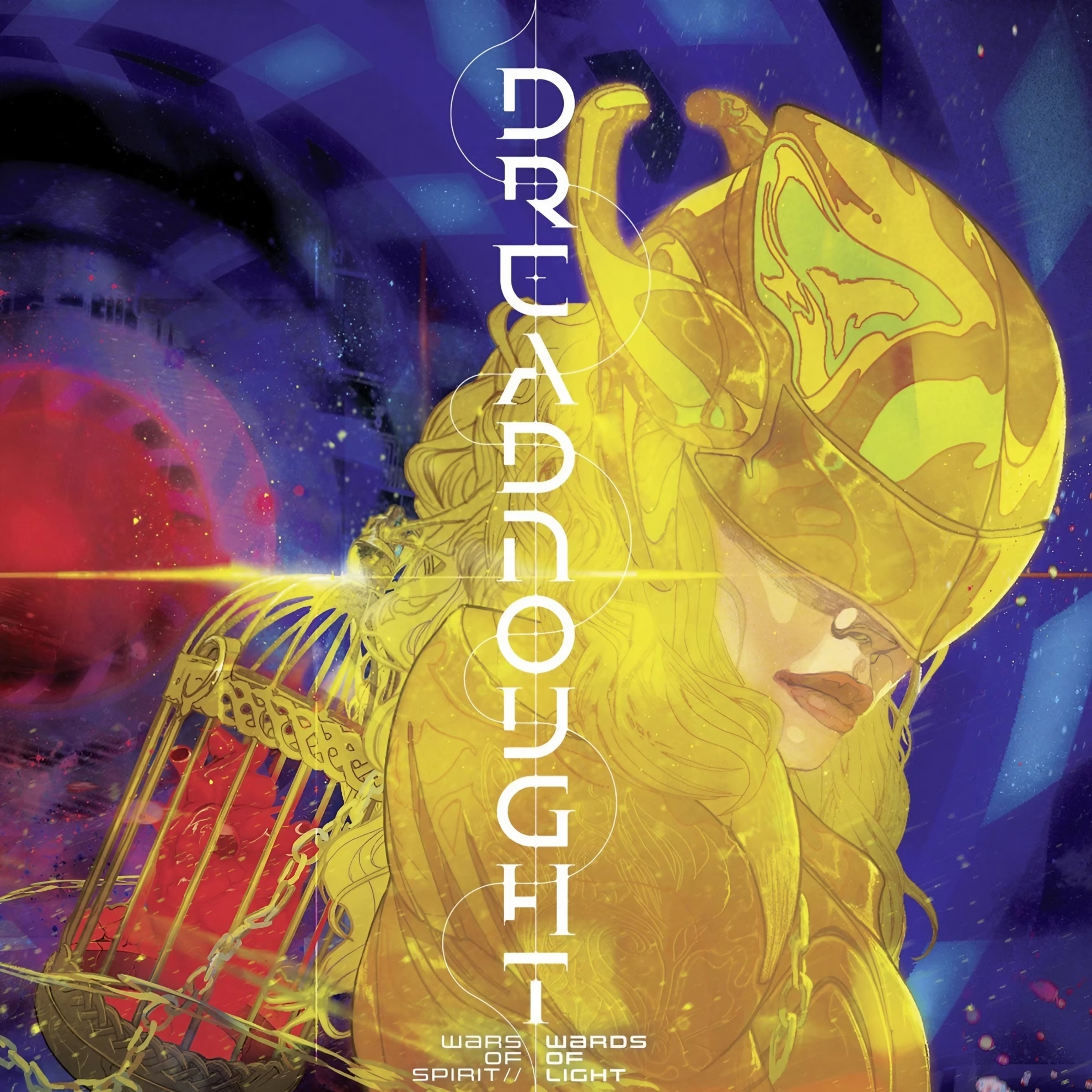
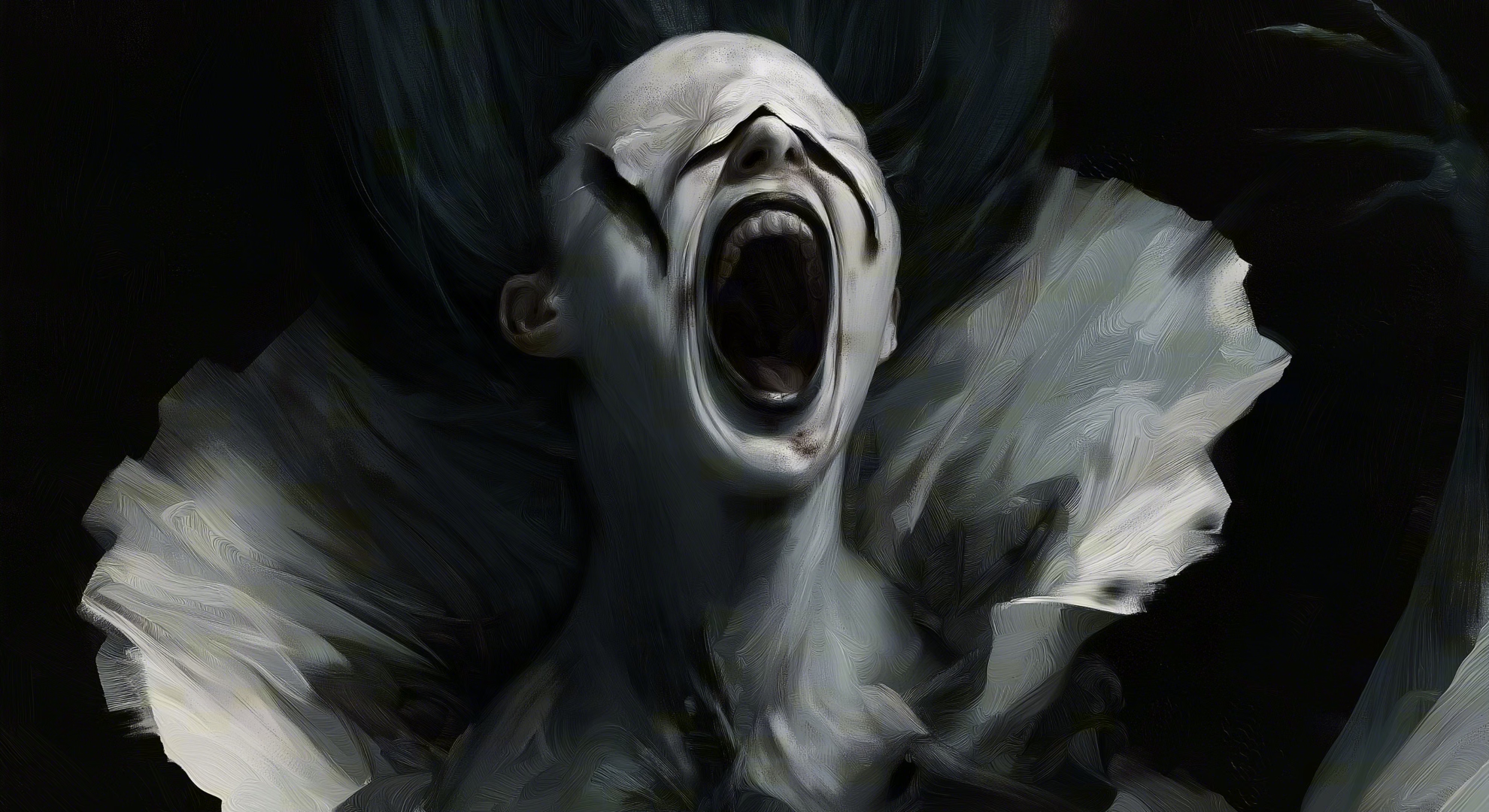
The album was produced by Dreadnought itself, recorded by Andy Patterson, the same engineer who worked on ‘Emergence’ in 2019, at Amusia Audio in the Denver metro area, mixed by Mauranen, and mastered by Jaakko Viitalahde, whose credits include Oranssi Pazuzu, Havukruunu, and Polymoon. Cover art comes from Christian Ward, winner of the Eisner Award, whose credited visual language runs toward saturated, kinetic color fields.
The Mother Whose Body Became Sky
The Enuma Elish survives on seven cuneiform tablets recovered largely from the library of the Assyrian king Ashurbanipal at Nineveh, though the poem itself is generally dated several centuries earlier.2 It narrates the emergence of the Mesopotamian pantheon from Tiamat, the personification of salt water, and Apsu, the personification of fresh water, whose union produces the younger gods.
When the younger gods’ restlessness disturbs Apsu, he moves to destroy them and is killed first, by the god Ea. Tiamat, transformed by grief and by the urging of her new consort Kingu into a figure of vengeance, assembles an army of monstrous beings to avenge him.
Marduk, Ea’s son, is chosen as the gods’ champion on the condition that he receive supreme authority in return. He kills Tiamat, and shapes the ordered cosmos out of her divided body: her upper half becomes the sky, her lower half the earth, her eyes the sources of the Tigris and Euphrates.
This is creation as the direct consequence of conflict, in which the cosmic order that follows is inseparable from the violence that produced it. By opening ‘Wars of Spirit // Wards of Light’ with a song called ‘Tiamat’s Gate,’ Dreadnought place the album’s own light-against-dark structure inside that older frame. The record’s two-part title, spirit set against ward, suggests not a simple binary but two forces that require each other to mean anything at all, in the same way Marduk’s sky requires Tiamat’s death to exist.
This is myth, not history, and the record treats it that way: a story handed down through a specific literary tradition, not a claim about events that occurred. What the band borrows is the structure of the story, not its status as fact.
Denver Roots, a Finnish Hand
Dreadnought’s home tradition is not a generic American metal but something more specific: the Rocky Mountain strain of progressive doom that grew up alongside the region’s DIY, festival-driven infrastructure rather than a major-label pipeline.
The tradition owes as much to the extended compositional logic of nineteen-seventies progressive rock as it does to doom metal’s slower tempos, and its practitioners’ use of counterculture-era structural ambition to reach beyond song form is well documented in writing on that earlier movement.3
Dreadnought’s flute passages and shifting time signatures place them closer to that lineage than to the riff-driven simplicity often associated with American doom’s Southern strain.
The producer chosen for this record draws from an entirely different, and equally specific, tradition. Julius Mauranen’s reputation rests on his work with Oranssi Pazuzu, a band whose psychedelic black metal treats repetition, drone, and electronic texture as compositional material in ways closer to a broader Finnish experimental underground than to Norwegian black metal’s earlier, more austere template, an aesthetic lineage scholars of the genre have located specifically in how production choices reshape a song’s meaning rather than merely its surface.4
Layering that sensibility onto a band already comfortable moving between folk instrumentation and blast-beat density does not flatten either tradition into the other. It lets a documented American strain of genre-crossing metal meet a documented Finnish one, on the specific ground of a shared refusal to stay inside a single sound.
That meeting point matters beyond personnel credits. The same audience that gathered at Red Eagle Campground for Enslaved, Borknagar, and Sigh already has direct, repeated contact with the kind of internationally rooted extreme metal Mauranen represents through Oranssi Pazuzu. Dreadnought’s move toward that same musical vocabulary is not an imported flourish so much as a documented convergence between two scenes that already share a stage.
The Light After the Chaos
Dreadnought’s return to the myth of a cosmos shaped from combat is not decoration. It restates, in the band’s own terms, an argument the group has been making in different forms since ‘Lifewoven’: that the genres it refuses to separate, folk warmth, doom’s slow weight, black metal’s velocity, were never actually opposed categories to begin with, only forces that had not yet been asked to share a room.
What changes on ‘Wars of Spirit // Wards of Light’ is who else is asked into that room. A Colorado band self-producing its sixth record, working through a newly founded European label, and placing a Finnish producer’s aesthetic beside its own accumulated catalogue, is not simply expanding its sound. It is making explicit an argument the band’s entire catalogue has implied: that the genre-crossing instinct driving Dreadnought since 2013 was never a regional idiosyncrasy so much as one recognizable version of a wider, internationally distributed appetite for music that refuses to sit still.
Six albums and 13 years in, Dreadnought are still testing how much territory a single record can hold without breaking apart. ‘Wars of Spirit // Wards of Light’ answers that question the same way Marduk answered Tiamat: not by choosing a side, but by shaping the next thing directly out of what came before it.
Does pairing a Colorado band’s genre-crossing catalogue with a Finnish producer’s aesthetic signature change how the resulting record should be heard, or does it simply make explicit a connection that was already there?
If you are a band, artist, label, or promoter navigating the dark and independent scene, you need press materials that speak the language — not generic copy. Our Studio writes press releases, EPKs, bios, and website content for the underground and the vanguard alike. Plans start at $150, with turnaround as fast as 2 days.
References
- Deena Weinstein, ‘Heavy Metal: The Music and Its Culture,’ rev. ed. (New York: Da Capo Press, 2000), 128-134. ↩︎
- W. G. Lambert, ‘Babylonian Creation Myths’ (Winona Lake, IN: Eisenbrauns, 2013), 3-9, 190-201. ↩︎
- Edward Macan, ‘Rocking the Classics: English Progressive Rock and the Counterculture’ (New York: Oxford University Press, 1997), 32-40. ↩︎
- Michelle Phillipov, ‘Death Metal and Music Criticism: Analysis at the Limits’ (Lanham, MD: Lexington Books, 2012), 55-63. ↩︎

Leave a Reply