

The horror comic book and the horror film have always maintained an uneasy kinship, each borrowing from the other in ways neither fully acknowledges. EC Comics drew on the moral logic of the crime film and the creature feature; the British Invasion of the 1980s pushed into territory that the American screen could not yet occupy.
What has remained comparatively rare is the deliberate, structurally planned movement in the opposite direction — a filmmaker of Carpenter’s documented stature entering the comics form not to license a property or promote a film, but to produce an original work that has no screen equivalent.
Storm King Comics, founded by Sandy King in 20131 as an independent division of Storm King Productions, has been that rare vehicle: a horror and science fiction publisher operating entirely outside the direct-market infrastructure of the major publishers, sustaining a coherent house aesthetic through anthology and limited-series formats across more than a decade of output.
Its 50th graphic novel milestone, announced alongside ‘Cathedral,’ is not a figure designed to impress by sheer volume — it is evidence of sustained independent genre publishing maintained without distributor guarantees or mainstream corporate support.
An Abandoned Church, a Dead Officer, a Deep Evil
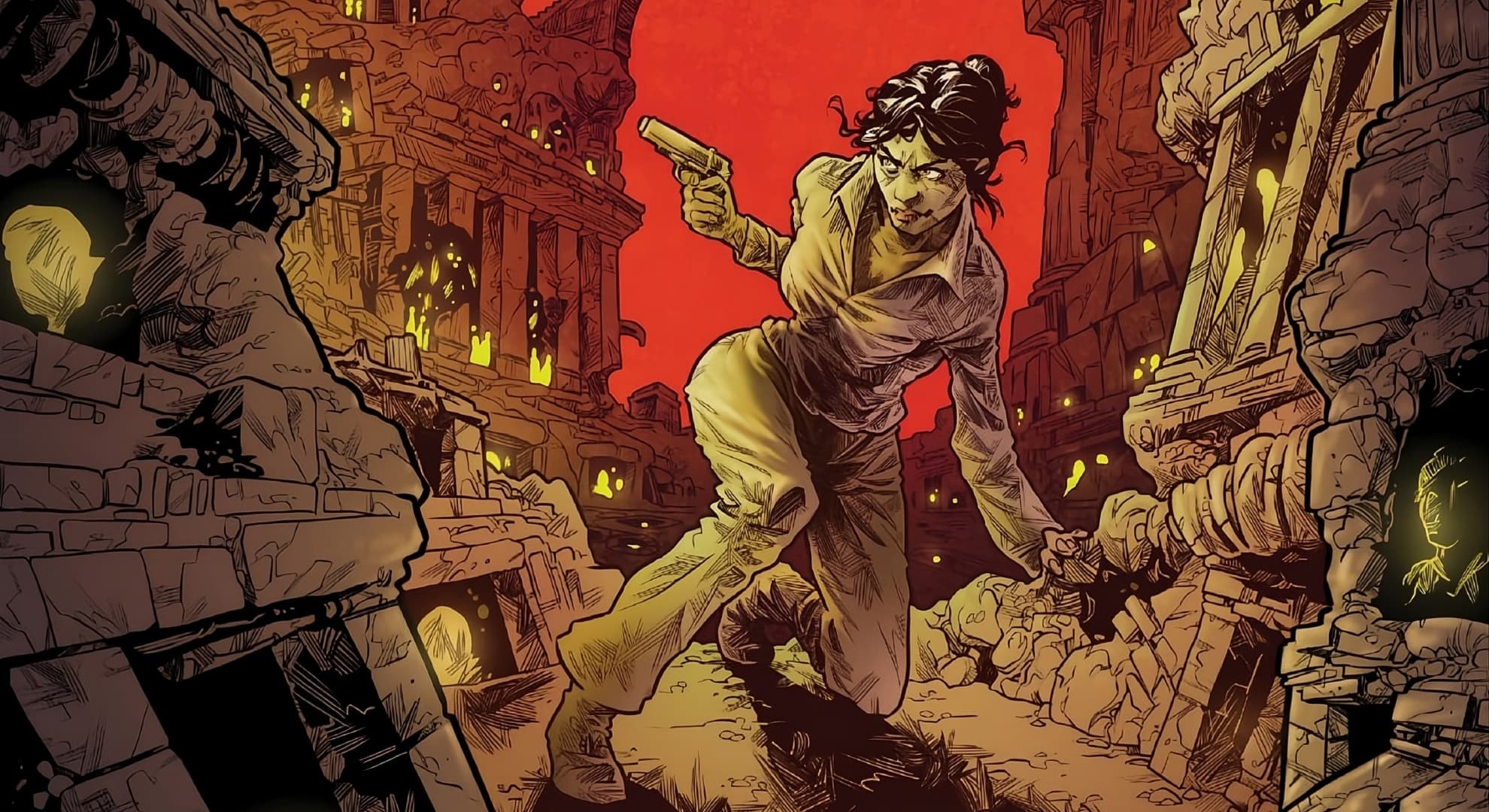
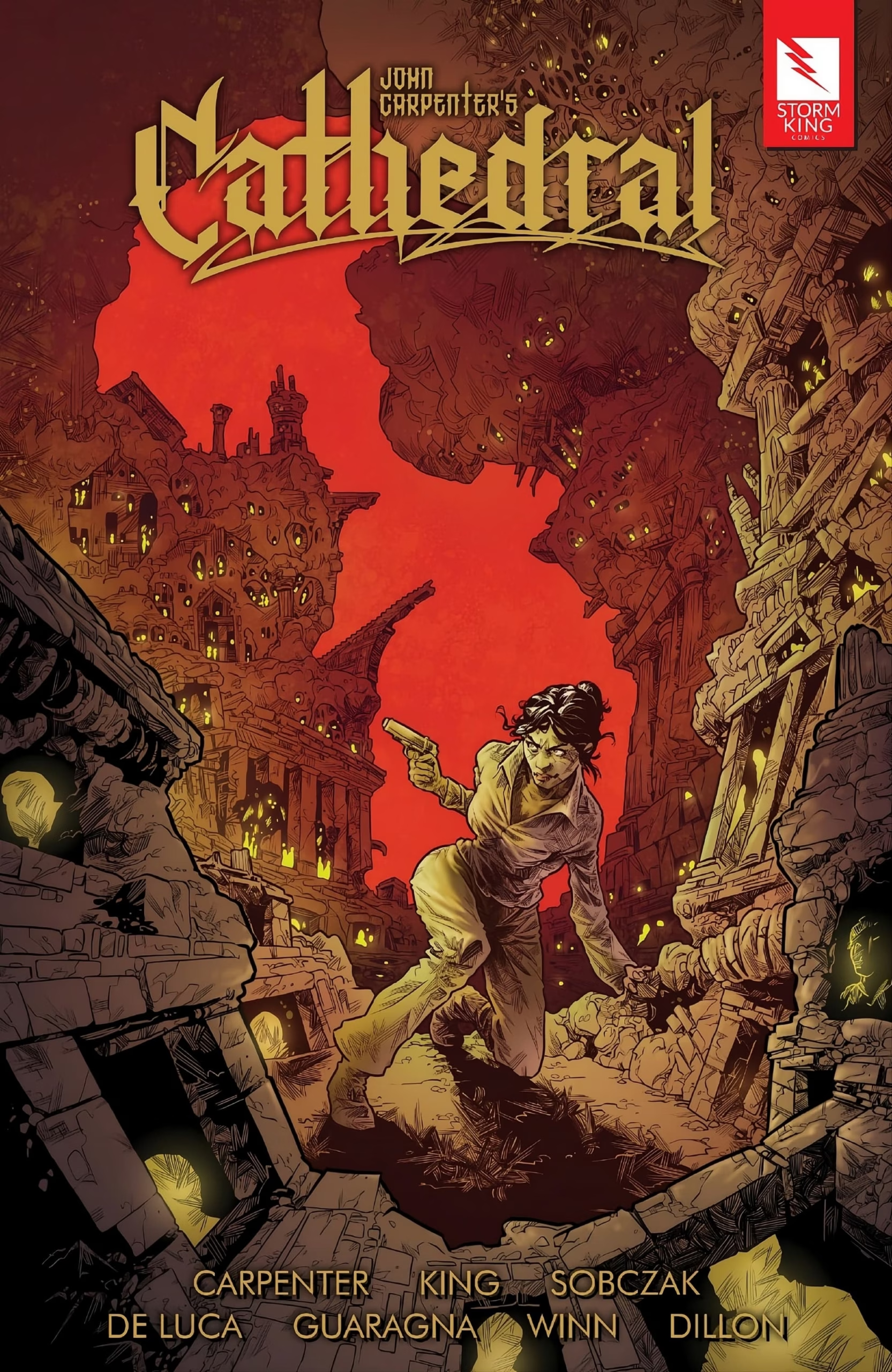
‘Cathedral’ is set in the middle of downtown Los Angeles, where a dilapidated church stands fenced off and unobserved on a busy street. The building and what lives beneath it enter public consciousness only when a police officer is murdered inside its walls, drawing Lieutenant Christine Marks, along with detectives Paul Hernandez and Steve Mayfield, into an investigation that takes them progressively deeper into the cathedral’s catacombs and toward a centuries-old supernatural entity imprisoned within.
The scenario operates within a tradition of institutional American Gothic that Carpenter has worked in across his career: the sealed building that harbors something the outside world has learned not to look at, the police officer whose professional authority is systematically stripped away by an encounter with something that exceeds the categories of law.
‘Prince of Darkness’ (1987) placed a cylinder of liquid Satanic evil in an abandoned Los Angeles church and sent a team of scientists and students in after it; ‘The Fog’ (1980) used a coastal town’s institutional amnesia about an old atrocity as the mechanism through which its horror erupts. ‘Cathedral’ takes the same structural logic and relocates it entirely to the page, in a form that forces commitments of visual duration and spatial sequencing that cinema — particularly Carpenter’s cinema, which has always privileged the long take and the widescreen frame — cannot replicate.
The graphic novel is co-written by Carpenter with Sandy King, his longtime creative partner, and Sean Sobczak, a writer with multiple prior credits in the ‘Tales for a HalloweeNight’ anthologies and the ‘Dark & Twisted: Death Mask’ one-shot (2023). Illustration is by Federico De Luca and Luis Guaragna, both with prior work in ‘Heavy Metal.’ Marshall Dillon handles lettering.
The Multimedia Object
What distinguishes ‘Cathedral’ from a standard publisher announcement is the deliberate construction of the graphic novel and a companion album as a single interdependent experience.
Each of the 14 tracks on the album — recorded by Carpenter, Cody Carpenter (synthesizers), and Daniel Davies (guitar) for release on August 7th, 2026, via Sacred Bones Records — corresponds to a specific chapter of the graphic novel, with liner notes designed to guide readers through the narrative in sequence.
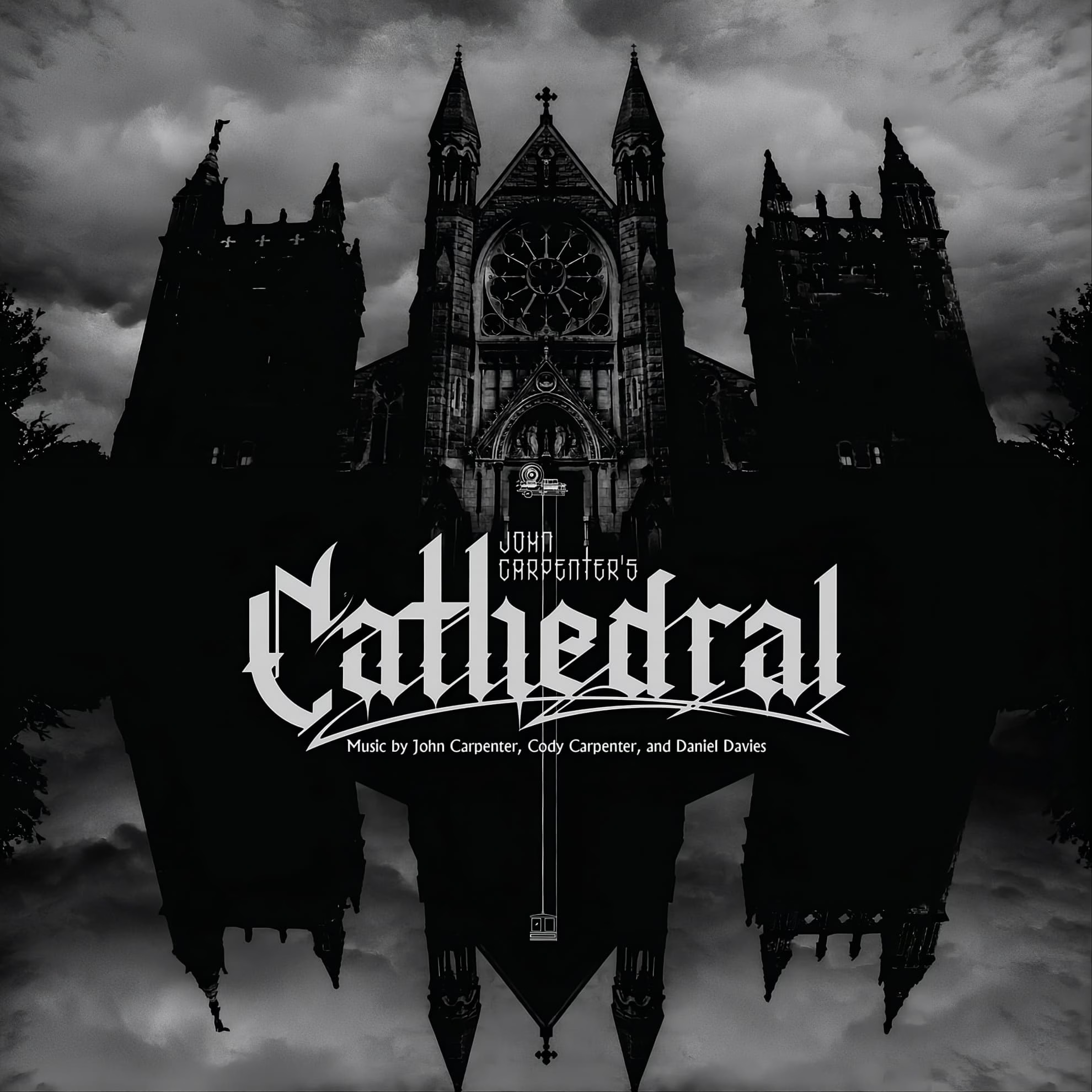
The album’s sonic approach is notably different from the minimalist synth-driven aesthetic of the ‘Lost Themes’ series (2015–present): Carpenter has described it as the trio’s first heavy metal record, with Davies’ guitar work anchoring tracks such as ‘Primeval’ and ‘Lord of the Underground’ and Carpenter’s piano sitting in an explicitly disorienting register against those textures.
The synchronized narrative — image, page, and sound designed as a single experience — has documented precedent in the progressive rock concept album and its accompanying illustrated booklets of the 1970s, a format that the independent vinyl revival and small press comics community have returned to intermittently since the early 2010s.
What ‘Cathedral’ pursues is a more structurally integrated version of that tradition: not an album that accompanies a comic but an album that is, in Carpenter’s framing, the closest approximation of a new film he has produced — an experience that requires both objects to function as designed.
Storm King’s Place in Independent Horror Publishing
Storm King Comics has published more than 100 issues and 30 graphic novels and trade paperbacks since its founding, sustaining an editorial identity organized around horror and science fiction publishing for an adult readership and, through its Storm Kids imprint, launched in 2019, for younger audiences.
Its primary properties — the annual ‘Tales for a HalloweeNight’ anthology, the ‘Tales of Science Fiction’ series, and the ‘Night Terrors’ line — have maintained an anthology model that has no direct equivalent in the current independent horror comics market, where single-series launches and limited miniseries dominate.
The publisher’s consistent self-distribution strategy — selling directly through its own site, bookstores, and comic shops without dependence on a single distributor — has been a structural feature of its operation since inception. That model is directly relevant to ‘Cathedral’: whatever Carpenter’s name recognition in mainstream horror contexts, the book arrives as a Storm King title, subject to Storm King’s distribution terms, reaching the audience that has followed the publisher’s output rather than a mainstream channel audience encountering horror comics through the filmmaker’s name.
‘Cathedral’ is also, by the publisher’s own accounting, Carpenter’s first original graphic novel — a distinction worth holding precisely. His prior contributions to Storm King properties have been as co-editor and contributor to anthology volumes: the ‘Tales for a HalloweeNight’ series, ‘Asylum,’ and ‘Tales of Science Fiction.’
A chapter preview of ‘Cathedral’ appeared in ‘Tales for a HalloweeNight’ Vol. 11 — a deployment that positions the anthology series as the proving ground for a longer project, rather than as the endpoint of Carpenter’s engagement with the form.
The Dream Origin and the Formal Consequence
Carpenter has stated that the work originated in a dream he had in 2024 — described in press materials as a nightmare landscape populated by creatures too aberrant to exist in daylight. The original impulse was musical: he reports his first response to the dream was the conviction that he needed to score it.
The graphic novel followed from that compositional impulse, rather than the other way around, which is formally unusual and materially significant for how the published object is organized: the album is not supplementary to the book but is, by design, its parallel and equal component.
What that origin means for the horror reader is that ‘Cathedral’ arrives as an explicitly non-cinematic horror object that is nonetheless organized according to cinematic principles — the chapter-track correspondence enforces a durational logic on the reading of the book, a pacing imposed from outside the page sequence.
Whether De Luca and Guaragna’s visual approach accommodates or resists that external structure is a question the finished work will answer; in the absence of released interiors at the time of this writing, what the announcement establishes is that the formal ambition is explicitly there.
Dreaming on the Page
The announcement of ‘Cathedral’ is significant not because Carpenter is a recognizable name attached to a horror comic — Storm King’s output has never depended on that recognition alone — but because the work is positioned as a fully original object designed to operate in a medium that has its own formal demands, demands that are not reducible to film adaptation or illustrated screenplay.
The horror graphic novel, when it functions at its formal best, does things with time, with the architecture of the page, and with the sustained duration of the reader’s gaze that no other medium replicates. ‘Cathedral’ is the first occasion on which Carpenter has committed to those demands for a single, sustained work.
Whether the multimedia object Carpenter and King have designed — book and album as a unified experience — finds an audience through Storm King’s existing distribution channels or reaches beyond them matters less than the formal fact of what has been designed.
Independent horror publishing’s most interesting recent output has consistently come from publishers willing to treat the comics object as something other than a promotional vehicle or a licensing exercise. ‘Cathedral’ meets that standard based on the evidence available.
How does the chapter-by-chapter alignment between the ‘Cathedral’ album and the graphic novel’s narrative structure alter the pacing and reading experience a horror comics reader would normally control independently — and what precedents exist in the medium’s history for externally imposed durational structure of this kind?
Leave a Reply