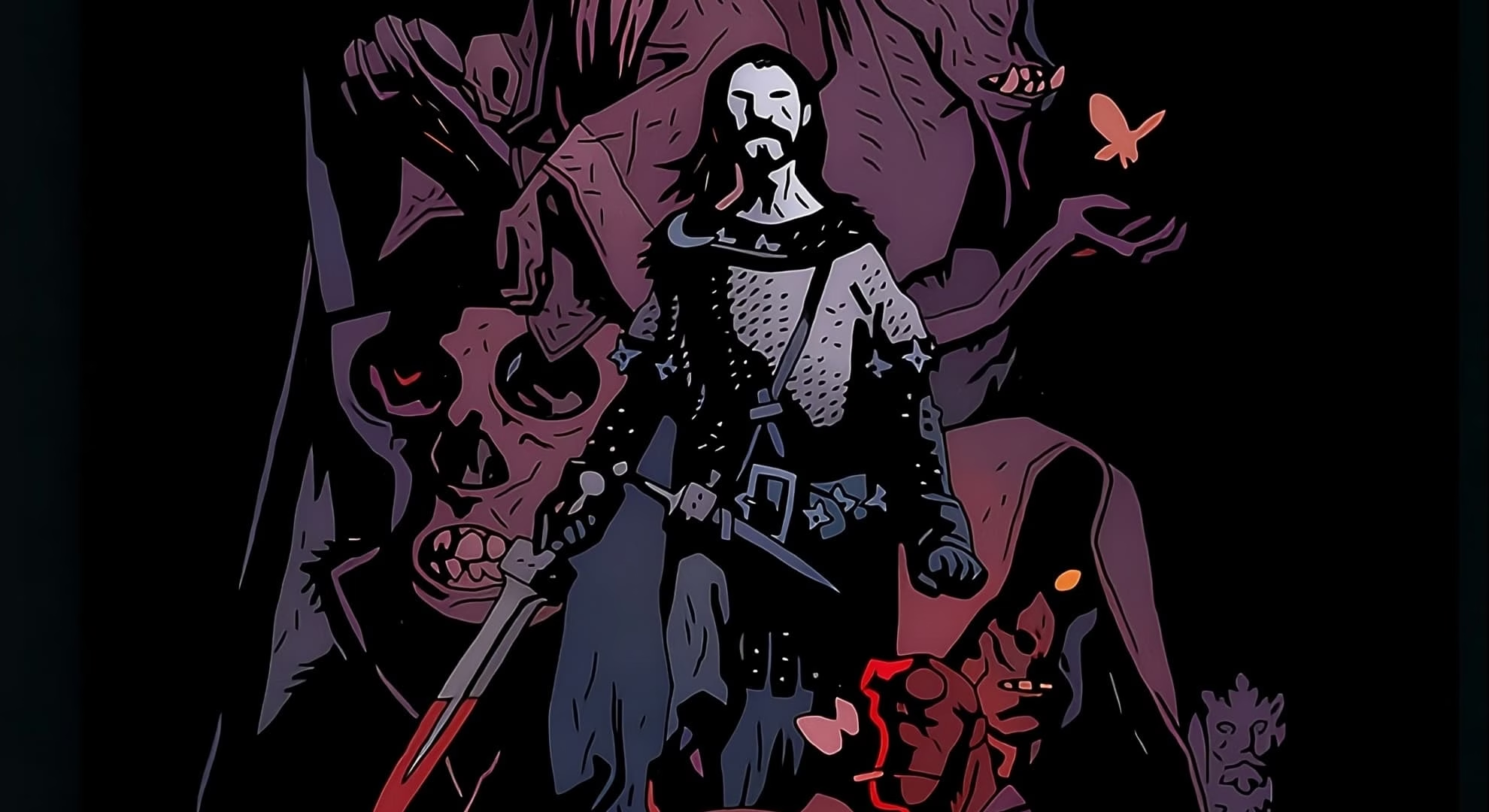


The problem of the external soul—the idea that a living being’s mortality can be separated from their body and hidden in a remote, nested sequence of objects—is one of folklore’s most persistently strange propositions. It appears in East Slavic fairy tales at least as far back as the eighteenth century, though the tradition is certainly older, in the figure of Koshchei Bessmertnyi: an unkillable sorcerer whose death is concealed inside a needle, inside an egg, inside a duck, inside a hare, inside an iron chest buried on the mythical island of Buyan.
Vladimir Propp’s structural analysis of Russian wonder tales identified the external soul motif as a key mechanism in the defeat of the villain—a narrative switch that converts the ostensibly unkillable into the ultimately mortal.1 What the oral tradition never pursued was the interior life of the unkillable man himself: his suffering, his history, the precise accumulation of terrible choices that brought him to immortality in the first place. That interior was Mike Mignola’s contribution.
What the Omnibus Collects
Dark Horse Comics has announced the ‘Koshchei the Deathless’ Omnibus HC, scheduled for release on June 16th, 2026, at $39.99 USD. The 368-page hardcover—lettered by Clem Robins, colored throughout by Dave Stewart, written by Mignola with art by both Mignola and Ben Stenbeck—assembles the complete published cycle for the first time in a single volume.
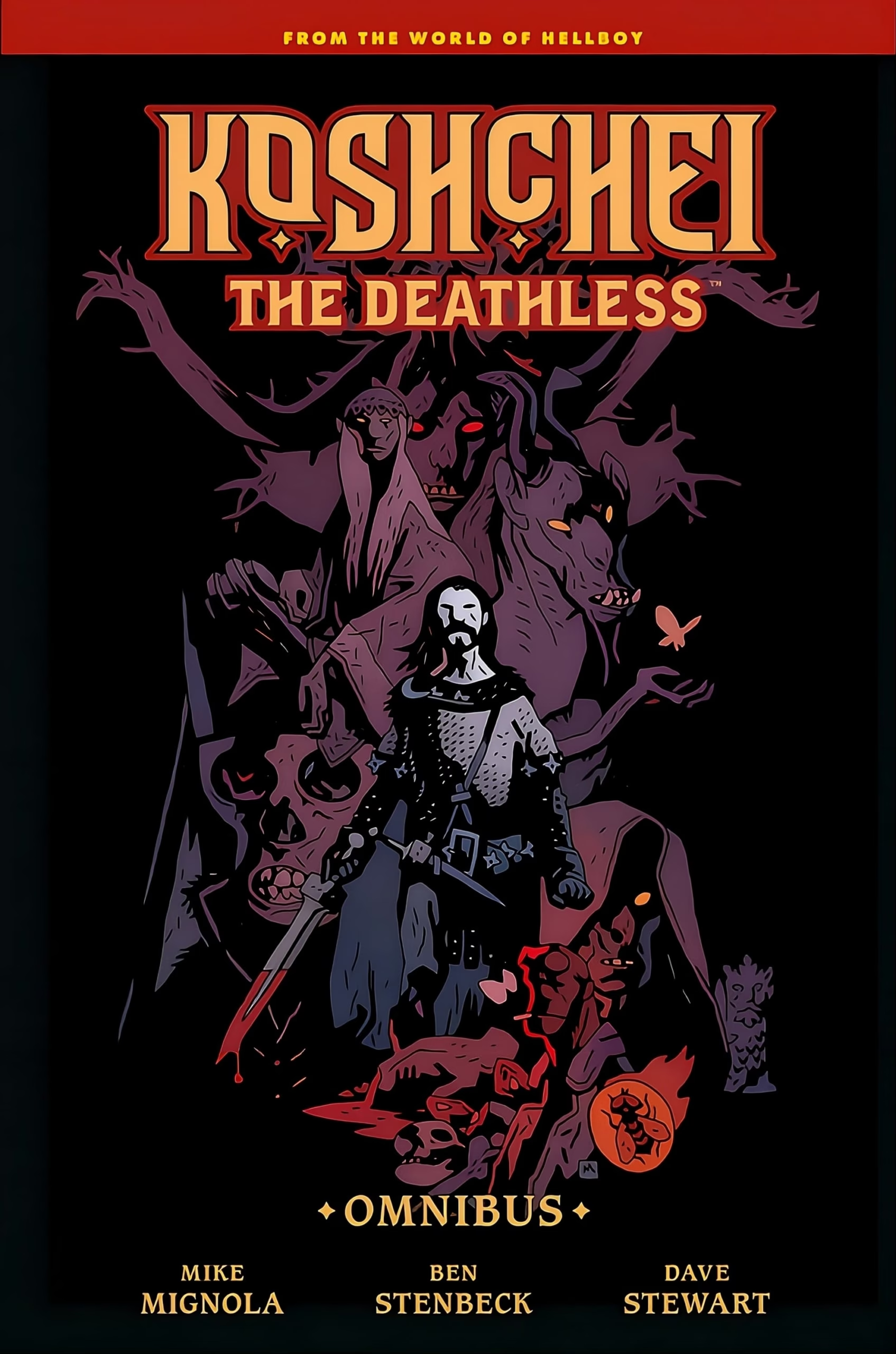
The contents span three distinct arcs. ‘Koshchei the Deathless’ #1–#6, originally published beginning in January 2018, frames the story as a long conversation between Koshchei and Hellboy in a bar in Hell: Koshchei recounting the terrible history of how he achieved immortality and why he eventually served Baba Yaga.
‘Koshchei in Hell’ #1–#4, which launched in November 2022, finds Koshchei still in Hell after the end of the world above, forced from his preferred retirement of wine and books by the arrival of an old associate with an urgent task. The collection then continues with the ‘Sir Edward Grey: Acheron’ one-shot and the three-issue ‘The Serpent in the Garden: Ed Grey and the Last Battle for England,’ where Koshchei’s story merges into the Witchfinder’s final arc—Ed Grey summoned by Alice, queen of the last standing realm, to defend England against Morgan Le Fay.
All epilogues are included, along with a cover gallery and sketchbook section.
Mignola, Stenbeck, and the Hellboy Universe
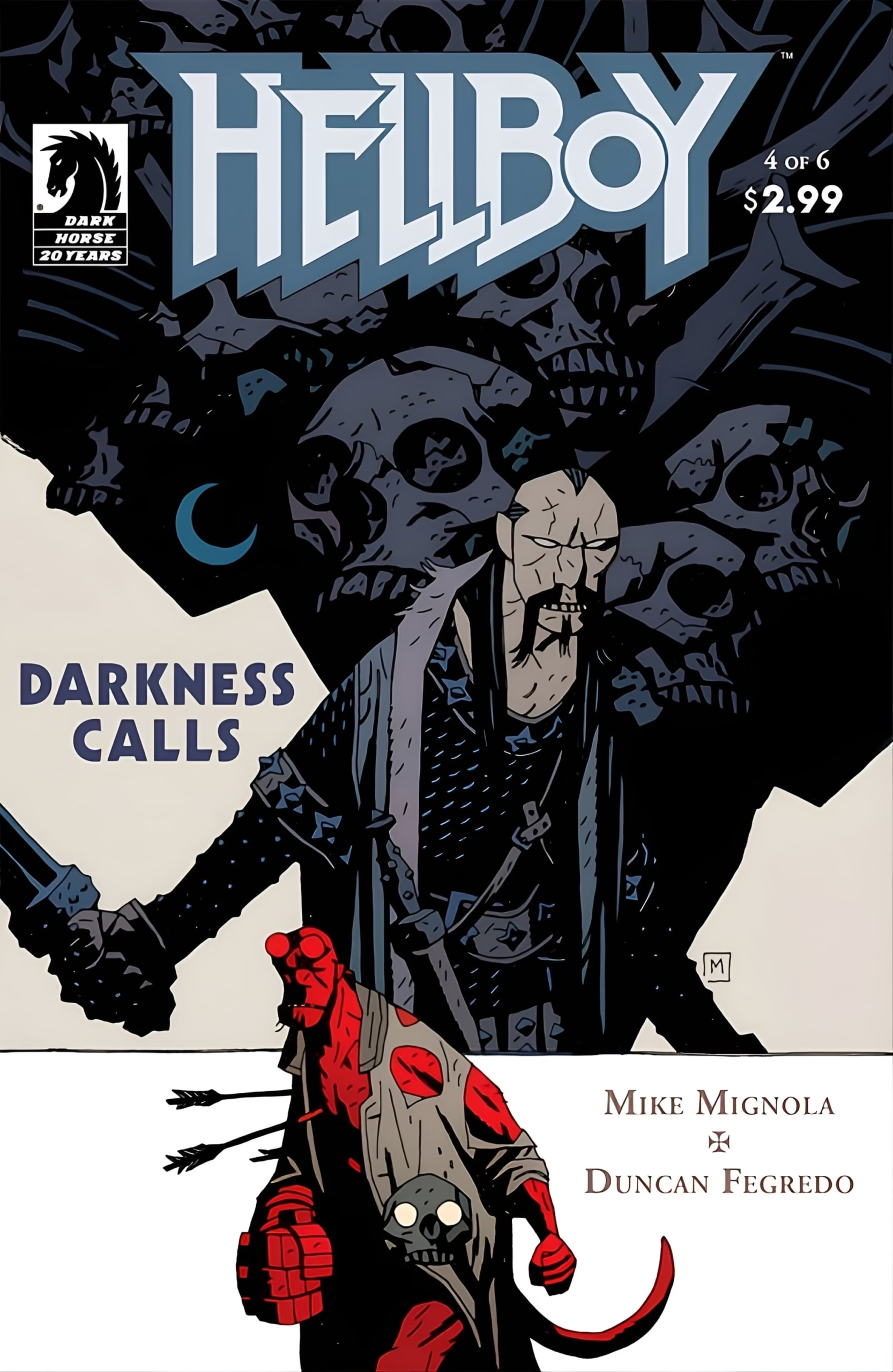
Mike Mignola introduced Koshchei as a secondary antagonist in ‘Hellboy: Darkness Calls’ in 2007: a figure dispatched by Baba Yaga to kill Hellboy, whose brief appearances suggested a long and unspoken prior life.
The choice to expand that implied history into a dedicated miniseries in 2018 was consistent with the general movement of the Hellboy Universe in its later phase—a systematic excavation of peripheral characters who had accumulated weight through accumulated context. Koshchei, unusually, was given the structure of a tragic confessional: a man recounting, in Hell, every act he committed on the road to becoming what he is.
Ben Stenbeck has been the primary visual collaborator on this strand of the Mignola universe since 2008, when he illustrated the ‘B.P.R.D.: The Ectoplasmic Man’ one-shot.
His work for Dark Horse within the Hellboy Universe includes ‘Witchfinder: In the Service of Angels,’ ‘Witchfinder: Murderous Intent,’ ‘Witchfinder: Beware the Ape,’ ‘Witchfinder: City of the Dead,’ ‘Frankenstein Underground,’ and multiple ‘Hellboy and the B.P.R.D.’ short stories set in 1953.
He also drew the complete ‘Baltimore’ run with Mignola and Christopher Golden, a separate horror series outside the Hellboy Universe. Stenbeck’s independent work includes ‘Our Bones Dust,’ published in 2024. The omnibus represents the conclusion of his longest continuous narrative collaboration with Mignola within the Hellboy Universe proper.
Colorist Dave Stewart, whose palette on the Hellboy Universe titles has been instrumental in defining how the series registers emotionally—earth tones fracturing into red, deep blues used as a form of spatial punctuation—returns here across all three arcs. Letterer Clem Robins, whose work on Hellboy began with the earliest series, completes the creative team.
Folklore Logic and Comic Form
What makes the Koshchei material distinctive within the Hellboy Universe is the commitment with which Mignola uses the folklore’s internal logic as a structural principle, not merely a source of atmosphere.
The nested-objects motif—death hidden inside progressively smaller, more improbable containers—is not decoration in ‘Koshchei the Deathless’; it is the organizing principle of the narrative itself. Koshchei’s immortality is treated as contingent on a specific set of conditions, and the story takes those conditions seriously in a way the source material never could, because the oral tradition’s interest was always in the hero who finds the needle, not in the man whose death is hidden inside it.
Stenbeck’s visual approach to this material has a particular quality that Mignola described in the 2022 announcement for ‘Koshchei in Hell’ as “something very natural and almost quiet—subtle—til it’s time to NOT be subtle.” The line is useful. Stenbeck’s draftsmanship in the Koshchei issues favors wide panels with generous negative space, figures often placed at the margins of the frame rather than its center, and a controlled restraint in the rendering of violence that makes the moments of rupture—when Stenbeck chooses to fill the panel with action—register as genuine interruptions of the narrative calm.
His faces in these stories carry the weight of accumulated history in a way that pure Mignola figures, with their more emblematic quality, do not: Koshchei, as Stenbeck draws him, is a man who looks like he has lived a very long time and regrets most of it.
Stewart’s color choices across the Koshchei arcs distinguish the Hell sequences from the post-apocalyptic Earth sequences by shifting the dominant palette from warms to colds—Hell rendered in amber and ochre, the ruined world above in grays and pale blues.
This is a formal decision that carries narrative weight, identifying Hell not as a place of punishment but as a strange kind of comfort, a permanent space, while the world above—despite nominally being the “real” world—has become the unstable and temporary one.
Dark Horse and the Horror of Mythology
Dark Horse Comics was founded in Milwaukie, Oregon, in 1986 by Mike Richardson, initially as an outlet committed to creator ownership—a structural position that distinguished it from the work-for-hire dominance of Marvel and DC at the time.
Horror was present in Dark Horse from its earliest years, though the publisher’s horror identity consolidated most fully around Mignola’s Hellboy Universe after 1994, which gave the publisher a sustained horror mythology of its own. The universe’s expansion into spin-off titles—B.P.R.D., Abe Sapien, Lobster Johnson, Sir Edward Grey: Witchfinder, Baltimore—produced one of the most elaborated horror mythologies in the history of American comics, drawing on folkloric traditions from East Slavic myth, Victorian occultism, Lovecraftian cosmic horror, and early twentieth-century Gothic literature simultaneously.
The Koshchei material represents one of the most specifically folkloric strands within that mythology. Where Hellboy draws on an eclectic amalgam of supernatural traditions, the Koshchei stories hold themselves to the internal logic of East Slavic folklore with unusual rigor—including Baba Yaga, the ambiguous witch figure who serves as Koshchei’s enslaver, exactly as she appears in the original tales: a figure of immense power who is neither straightforwardly malevolent nor reliably helpful.
The Independent Coherence Argument
A significant implication of the Omnibus format is the question of entry point. The Koshchei material, while developed within the Hellboy Universe, has a self-contained narrative arc that does not require extensive prior knowledge of Hellboy to follow.
The first miniseries opens with Koshchei and Hellboy already in Hell after events the reader has not necessarily witnessed; the bar conversation that structures the opening arc provides its own exposition, delivered in Koshchei’s voice, so that the Hellboy Universe context functions as backdrop rather than prerequisite.
A reader with no prior Hellboy history can enter the Omnibus and follow a complete narrative from origin to conclusion.
The collected format sharpens this quality. Across individual issues, the transitions between arcs required a degree of contextual recall that slowed entry. A single volume that moves directly from the conclusion of ‘Koshchei the Deathless’ into ‘Koshchei in Hell’ and then into the Witchfinder endgame removes that friction entirely, making the internal coherence of the cycle visible in a way that serialized publication necessarily obscures.
One Cycle, One Volume
The omnibus format in horror comics has a specific function that is distinct from its function in superhero publishing. A superhero omnibus is typically an archival gesture—a comprehensive gathering of material that continues to generate new installments.
A horror omnibus, when the collected material represents a genuinely closed narrative, is a different kind of object: it fixes the complete arc in a single reading experience and makes the formal coherence of the whole visible.
The ‘Koshchei the Deathless’ Omnibus belongs to the second category. The Koshchei cycle has a beginning—the conversation in the bar in Hell in which Koshchei recounts how he became what he is—and an end: the conclusion of the Witchfinder’s final struggle in post-Hellboy England.
The Omnibus does not gather ongoing material; it gathers a complete story. That distinction matters for how a reader approaches the volume, and for what Dark Horse is claiming about the material’s status within the larger mythology.
That the complete cycle runs to 368 pages—across 13 individual issues and one one-shot, plus all epilogues and supplementary material—confirms that the Koshchei material, taken together, constitutes a substantial and self-sufficient work of horror mythology. The question for readers of the Hellboy Universe who have followed the individual publications is whether the Omnibus reveals any formal argument in the complete sequence that the serialized reading experience suppressed.
For readers arriving at Koshchei for the first time, the question is simpler: whether a supernatural folk horror story that takes the logic of East Slavic mythology as its structural principle, drawn by one of the few artists working in the Mignola tradition who can sustain a full narrative rather than a short story, makes good on the premise.
The available evidence, in the form of 14 previously published installments, suggests it does.
The ‘Koshchei the Deathless’ Omnibus places a character drawn entirely from East Slavic oral tradition at the center of a horror narrative that ends in a post-apocalyptic defense of England. To what extent does this migration across folkloric traditions—Slavic source material entering a British Arthurian frame via an American publisher’s mythology—strengthen or dilute the specific cultural logic of the Koshchei figure?
Reference
- Andreas Johns, ‘The Image of Koshchei Bessmertnyi in East Slavic Folklore,’ SEEFA Journal V, no. 1 (2000): 7–24. See also Vladimir Propp, ‘Morphology of the Folktale,’ trans. Laurence Scott, 2nd ed. (Austin: University of Texas Press, 1968), 79–82. ↩︎

Leave a Reply