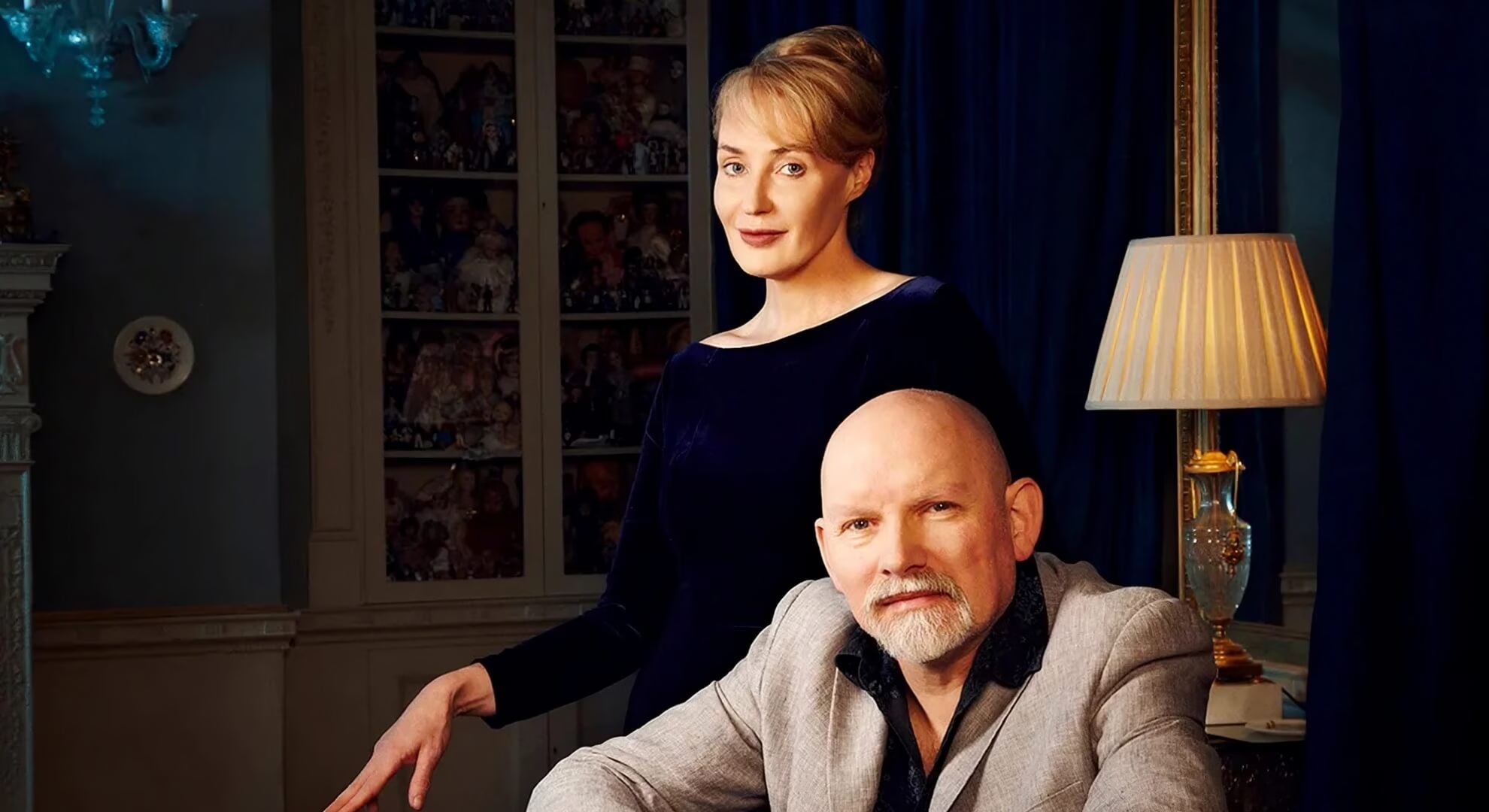


In the ancient world, a temenos was a sacred enclosure — a plot of land set apart from the profane, given over entirely to the presence of the divine. Brendan Perry chose the word deliberately when he named his recording studio on the outskirts of Epidavros, the Greek city whose fourth-century theater was built not for entertainment but for the healing of the citizenry.
That a musician of Perry’s particular disposition would settle here, in a landscape where ceremony and performance have always shared the same acoustics, is less a biographical footnote than a declaration of artistic intent.
The Accretion of Worlds
Dead Can Dance did not arrive at The Temenos by a conventional route. The Anglo-Irish collective, founded in Melbourne in 1981 by Perry and Lisa Gerrard before relocating to London the following year, spent the eighties and nineties assembling a body of work that drew from medieval European polyphony, North African percussion traditions, Gaelic folk, Gregorian chant, and the drone aesthetics of early ambient music.1
Their 1985 album ‘Spleen and Ideal’ conjured a consciously medieval European sound, its neoclassical darkwave register reaching number two on the British independent charts and establishing the approach Dead Can Dance would refine across a further seven studio records.
The 1993 album ‘Into the Labyrinth’ brought their broadest commercial moment: half a million copies sold, a position in the Billboard 200, and 4AD’s highest-selling act, yet Dead Can Dance never approached that success as an accumulation.
Their silence spoke as clearly as their music — a 1998 disbandment, a 2005 tour, a 2012 return with ‘Anastasis,’ a 2018 record on the myth of Dionysus, long stretches of quiet between each phase.
Against the Release Calendar
The 2026 series is something different — not a record in any conventional sense, but a structured offering: one new song per month, issued exclusively through Bandcamp on Dead Can Dance’s own Holy Tongue Records imprint, each accompanied by a digital PDF bearing song lyrics and original artwork. The format dispenses with the album campaign, the press cycle, the single-to-streaming funnel. It positions the work as a continuing practice rather than a product.
Epidavros — where Perry’s studio, The Temenos, takes its name from the ancient Greek term for a precinct set apart from ordinary use and given over to the sacred2 — is an appropriate environment for music that has always rejected the commercial calendar.
Perry has confirmed that Lisa Gerrard remains open to contributing to the series but is currently occupied with other projects. The 2026 tracks are, as of this writing, entirely his. Whether Gerrard enters the cycle later is one of the series’ unresolved questions, and one that Dead Can Dance’s official communications have left deliberately open.
Three Releases and What They Argue
‘Our Day Will Come,’ released on March 20th, 2026, arrived with a specific dedication: to the shared national aspirations of the Irish and Palestinian peoples. Its title is a direct translation of Tiocfaidh ár lá, the Irish republican slogan whose lineage in Perry’s cultural heritage needs no gloss.
Dead Can Dance committed 50 percent of the track’s sale proceeds to Medical Aid for Palestinians — a gesture that positions the release not merely as music but as ethical act.
On April 10th, 2026, between the first song and the second, Perry released ‘Mnemosyne’ — not a track but a lyric book in PDF form, offered via Bandcamp with a short accompanying audio extract. Its dedication, to the goddess of memory and mother of the Muses, frames the entire series.
In his preface, Perry names the writers who have shaped his language: J.G. Ballard, Philip K. Dick, William Blake, Charles Baudelaire, Arthur Rimbaud. The list is a map of the project’s preoccupations — dystopian futures, visionary dissent, symbolist interiority, the refusal of the surface.
Perry described memory, time, and future projection as recurring themes in his writing. ‘Mnemosyne’ is not incidental to the series; it is the series’ declared intellectual frame.
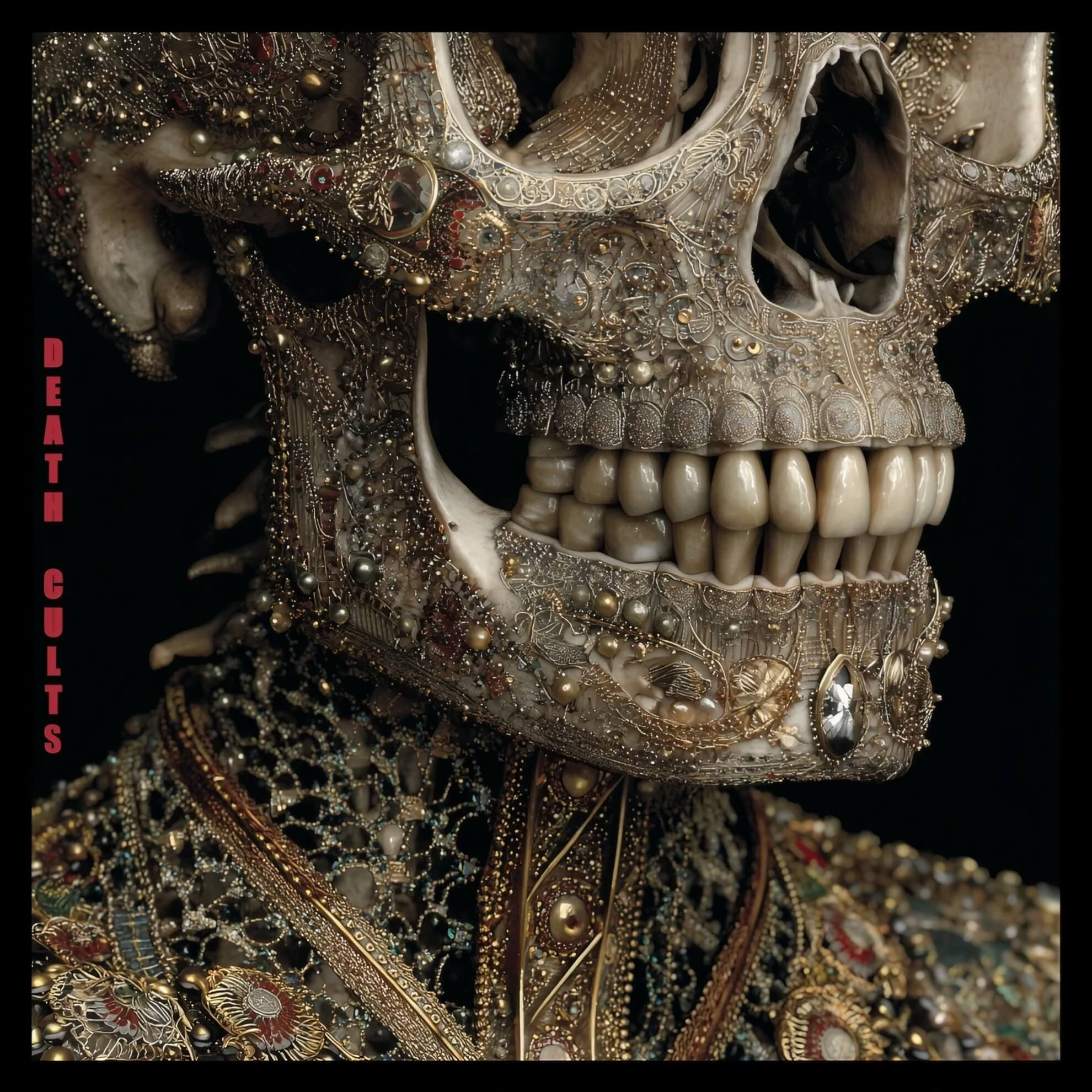
‘Death Cults,’ released April 17th, 2026, runs to eight minutes and 53 seconds. Recorded and mixed at The Temenos in Epidavros, its lyrics cast organized systems of belief as agents of environmental and metaphysical destruction, naming blind faith and the domination of nature among the civilizational afflictions of the present.
The thematic continuity with ‘Dionysus’ — Perry’s 2018 inquiry into ancient cult practice — is audible and intentional: where that record approached the ritual with the temperament of the archaeologist, ‘Death Cults’ approaches it with the temperament of the witness.
The recording environment lends the track a weight and deliberateness that exceeds the merely atmospheric — a music that seems to emerge from stone rather than speakers.
The Ceremony Continues
The 2026 sequence is, by Perry’s design, unfinished. Months remain in the year, songs have not yet been written or released, and whether the series will cohere into a larger body of work remains beyond what can be assessed now.
What the first two tracks establish is that Perry’s time at The Temenos has produced music in continuity with the longest-running preoccupations of the Dead Can Dance project: the relationship between the sacred and the human, between grief and ceremony, between a music drawn from the deep past and an audience living in a troubled present.
In a year when Dead Can Dance are offering their music one month at a time outside the conventional album system, what do ‘Our Day Will Come’ and ‘Death Cults’ tell you about what Dead Can Dance are still capable of saying — and what draws you to a project that refuses to reveal its shape in advance?
References
- Philip Bohlman, ‘World Music: A Very Short Introduction’ (Oxford: Oxford University Press, 2002), 44–47. ↩︎
- Walter Burkert, ‘Greek Religion’ (Cambridge: Harvard University Press, 1985), 86–88. ↩︎
Leave a Reply