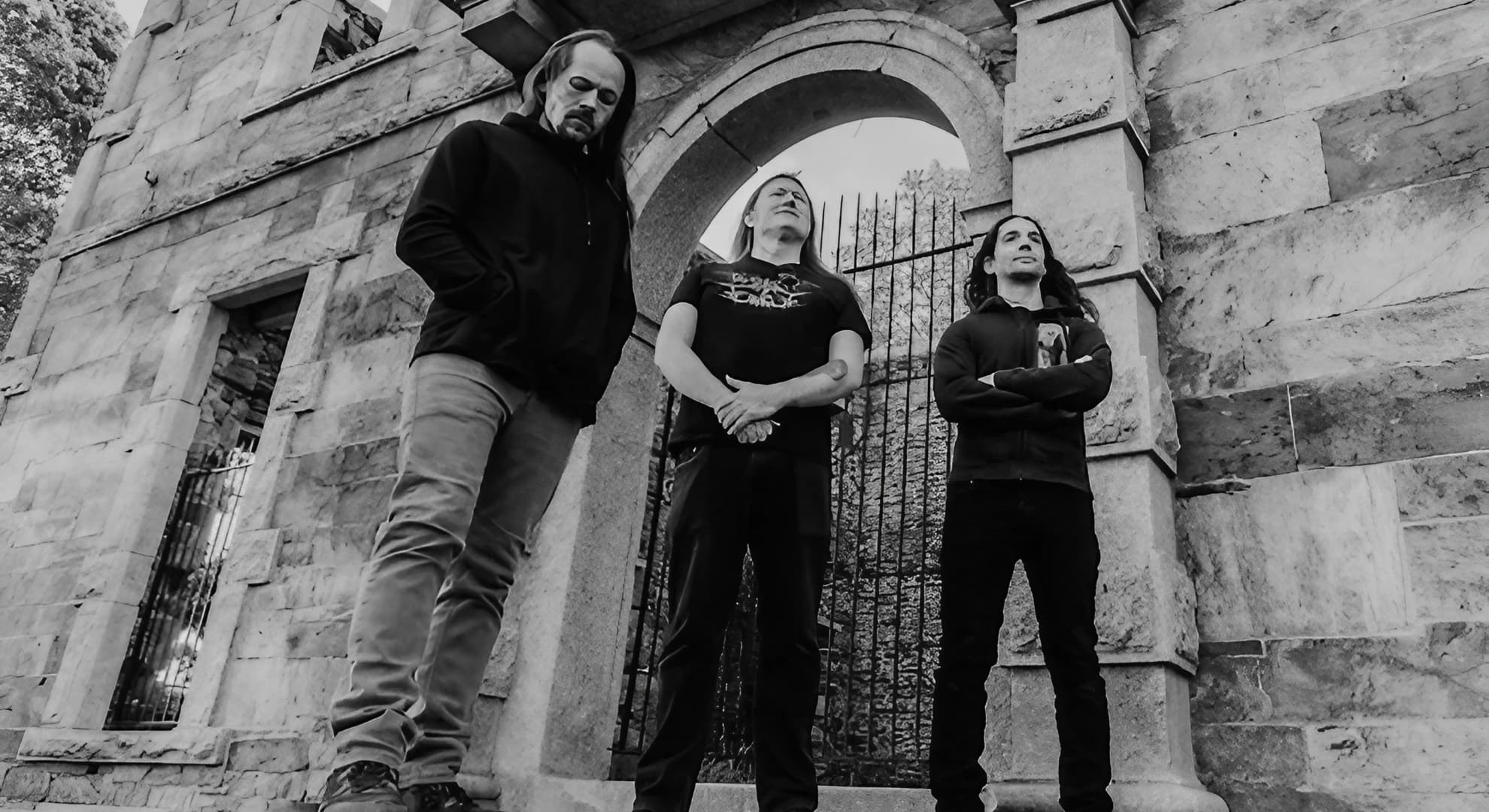


In the tomb complexes of the Egyptian Middle Kingdom, wealthy families packed small carved figures beside their dead: proxies meant to answer on the deceased’s behalf when the afterlife called for labor in the fields of the underworld. The figures worked so the dead did not have to. Three thousand years later, in Portland, Maine, a technical and progressive black and death metal trio took that same servant as its name, and on its third full-length record turns the old bargain inside out, asking what happens once the servant stops answering.
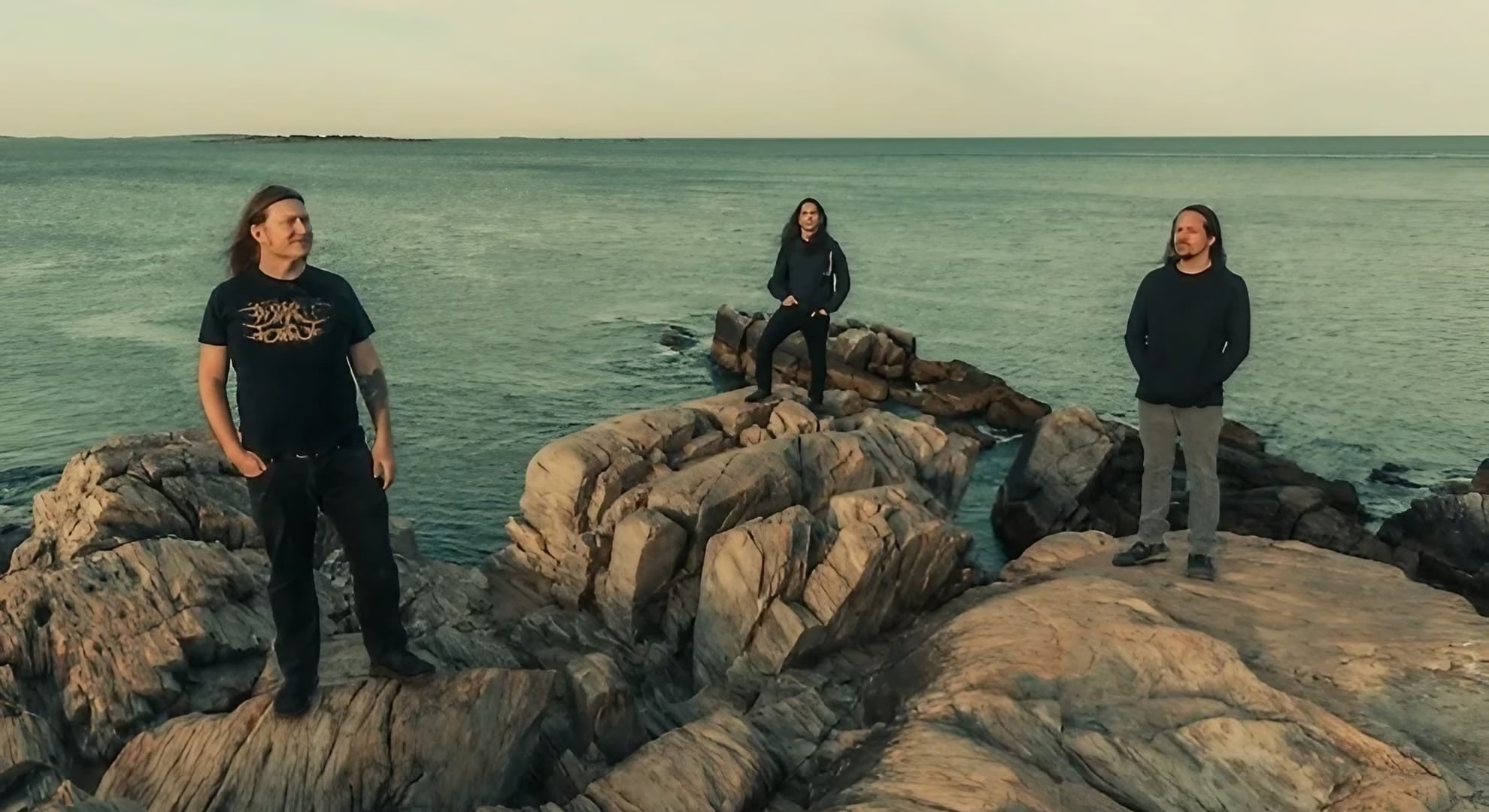
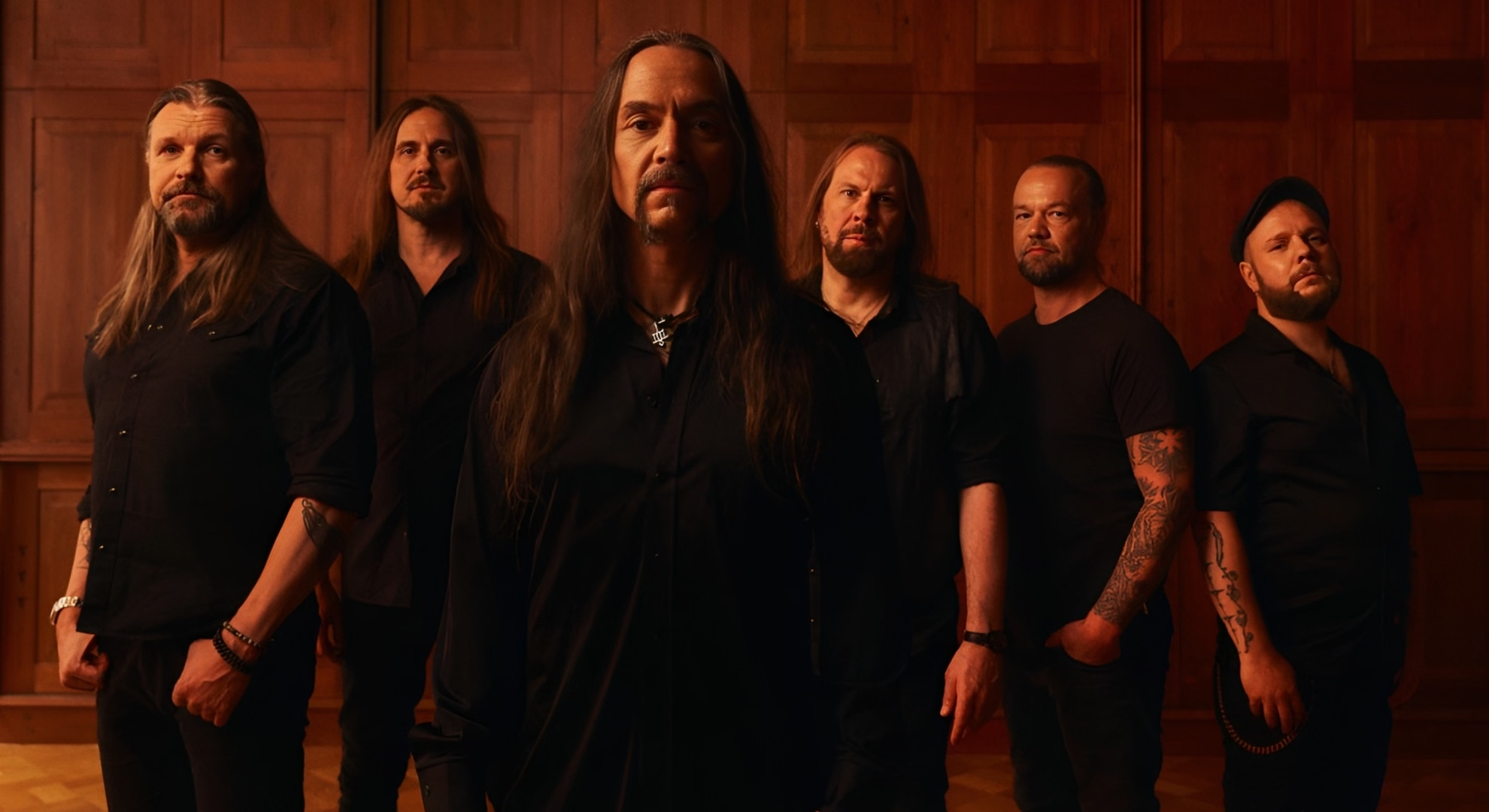
That band, Shabti, present ‘Haze, Cacophony, and White Light’ on August 21st through Contemn Light, a cassette run of 100 units backed by a digital edition. It is the group’s first full-length since 2019, a gap most bands do not survive with their lineup intact, and it comes as the settlement of a roster that took close to two decades to coalesce into its current form: guitarist and vocalist Rob Cook, bassist Brendan Hayter, and drummer Ray Capizzo.
The Servants Who Outlast Their Makers
The figures Shabti take their name from are formally known as shabti, or ushabti in later usage, and their function in Egyptian burial practice was specific rather than symbolic. Placed inside coffins and tomb chambers from the Middle Kingdom through the Late Period, the figures were inscribed with a spell instructing them to perform agricultural labor, land reclamation, and other compulsory work on behalf of the deceased whenever summoned in the afterlife.
Wealthier burials could include hundreds of them, one for each day of the year, along with a set of overseer figures to direct the rest, so that the dead person’s obligations to the gods of the underworld were discharged entirely by proxy.1
The concept the band borrows is not death or the underworld generally, but this particular structure: a created servant, manufactured to labor in place of its maker, bound by inscription rather than will.
‘Rise of the Shabti,’ the album’s closing track and lead single, takes that structure and projects it forward rather than backward. Vocalist and guitarist Rob Cook has described the song as following the last remnants of humanity as they abandon Earth in search of new habitation, supported and eventually succeeded by physical artificial intelligence, all that remains to carry their legacy.
Cook has noted that the shabti figures represent these constructs directly, tying the record’s imagery back to the funerary practice that named the band in 2008, and has stated that the song was written in 2023, with its resemblance to current debates about artificial intelligence being largely coincidental; he described the lyric as an apocalyptic meditation on human frailty carried through mythological reference rather than commentary on present events.
The transposition is exact: where the ancient shabti worked so the dead did not have to, the song’s constructs work until their makers are gone entirely, inheriting the labor and, implicitly, the world. This image, of a created order that outlives and eventually succeeds its makers, belongs to a much older tradition of apocalyptic writing than the current discourse around artificial intelligence, one that recurs across Western eschatological literature whenever a civilization has needed to imagine its own obsolescence.2
Two Decades Toward One Lineup
Shabti formed in Portland, Maine in the spring of 2008, the songwriting vehicle of guitarist and vocalist Rob Cook, formerly of Kurixis. The band’s first years were defined by turnover: a rotating cast of bassists and drummers passed through the lineup before it settled enough to record, drawn at various points from the city’s small but persistent extreme metal circuit.
Following two early demos, including a self-titled release, Shabti self-released its debut full-length, ‘Paracusia,’ in 2013, a record that paired technical death metal structure with black metal’s colder harmonic vocabulary.
That combination set the band apart from a parallel revival then underway in American death metal, one built on close, often self-professed replication of the Tampa scene associated with Death, Atheist, and Morbid Angel. Shabti’s blackened, technically minded approach marked a departure from that throwback tendency, aligning the band instead with a more exploratory, structurally restless wing of extreme metal that had less interest in reproducing a single regional style than in combining several.3
The Turn Toward ‘Trembling and Shorn’
Six years passed before the follow-up. ‘Trembling and Shorn,’ co-released with Last Mercy Emissions on March 22nd, 2019, sharpened the technical death metal side of the band’s sound considerably.
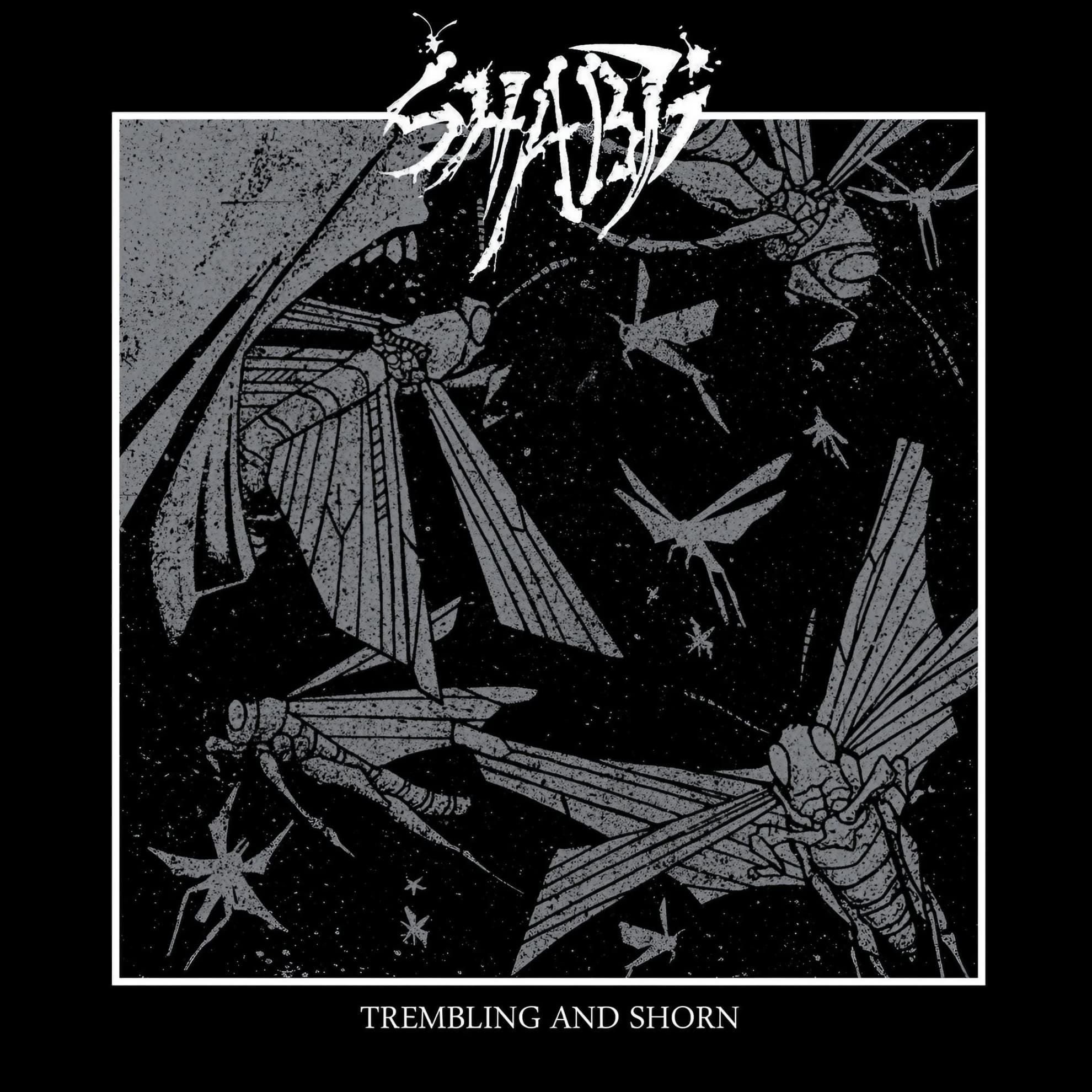
Guest guitar work from Jordan Guerette and keyboard passages from Dave Kaminsky widened the record’s arrangement without diluting its density, and mastering was handled by Colin Marston, a credit that placed the young band’s second record in company with some of extreme metal’s more demanding technical circles.
The record’s six tracks, ‘Shrouded and Veiled,’ ‘Seven Billion Souls,’ ‘Sanctify,’ ‘The Oracle and the Architect,’ ‘My Doppelganger,’ and ‘Below Deck,’ carried the band through a run of Northeastern United States tour dates alongside Churchburn, sharing stages with acts including Evoken and Unearthly Trance, and cemented Shabti’s standing within the regional death metal circuit that has since carried the band alongside Immolation, Today Is The Day, Primitive Man, Ghoul, Necrot, Blood Incantation, and Conan.
Three Bands Inside One Trio
The version of Shabti making this record differs from the one that toured behind ‘Trembling and Shorn.’ Guitarist and vocalist Rob Cook also performs with Worm Altar. Bassist Brendan Hayter holds studio roles in Obsidian Tongue and Fires In The Distance. Drummer Ray Capizzo occupies a more layered position: he is a full studio member of both Falls of Rauros and Obsidian Tongue, and performs live with Panopticon without holding a role on that project’s recorded output.
The distinction matters for how the album’s rhythmic vocabulary reads. Capizzo’s studio work with Falls of Rauros and Obsidian Tongue, rather than a formal compositional relationship with Panopticon, is the more direct source for the drumming on ‘Haze, Cacophony, and White Light,’ which favors abrupt tempo shifts and layered fills over the sustained blast a Panopticon connection might otherwise suggest.
Six Tracks Toward Succession
‘Haze, Cacophony, and White Light’ runs six tracks: ‘Ambrosia and Lamb’s Blood,’ ‘A Weary Creation,’ ‘Blood for a Blessing,’ the title track, ‘Sojourner,’ and ‘Rise of the Shabti.’ Its lyrics work as hazy reflections of past-lived experience filtered through mythological and dream imagery, moving through grief, longing, religion, and alienation before closing on the vision described above.
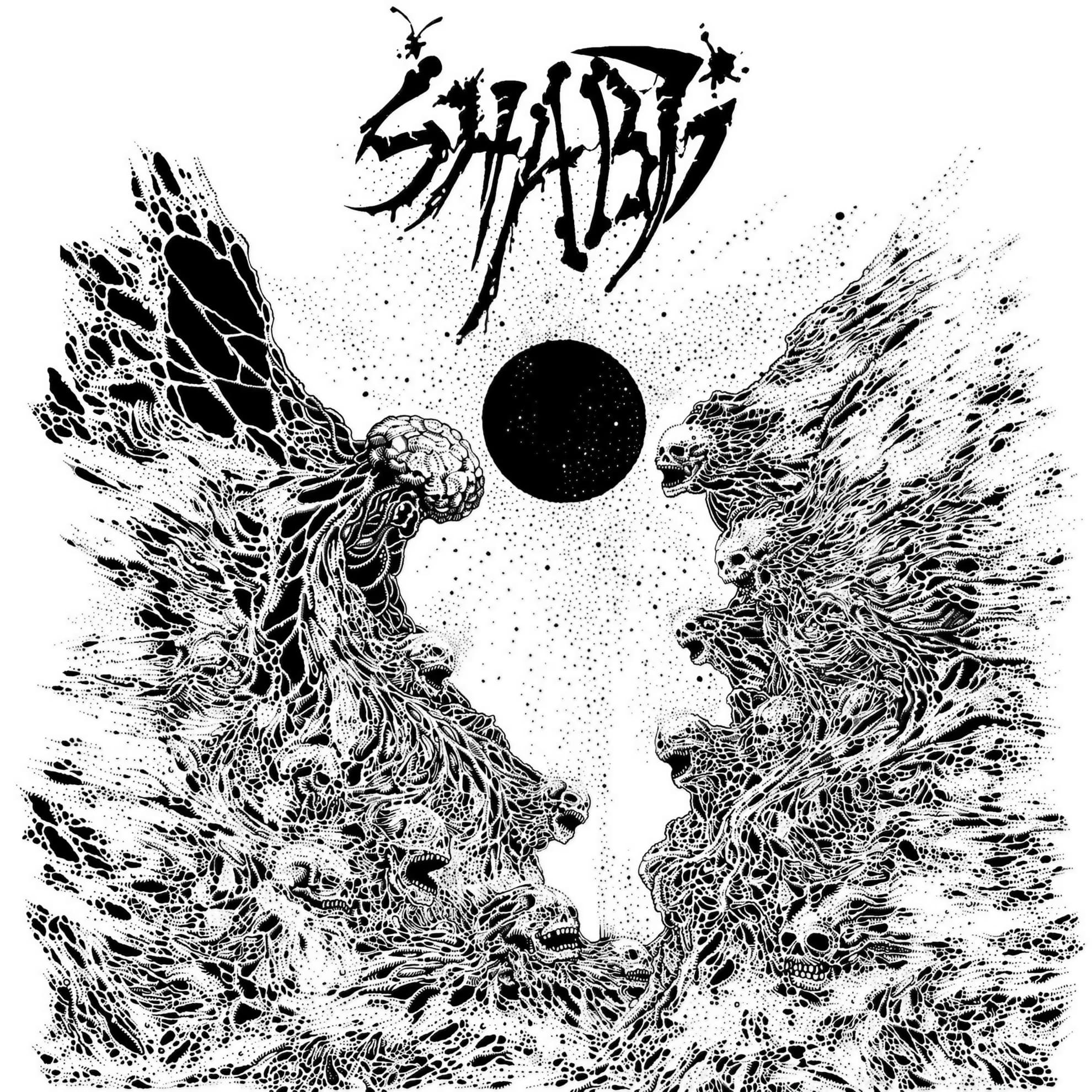
The album was largely tracked by the band itself, with additional guitar and vocal tracking handled by Todd Hutchisen at Acadia Recording Company in Portland, the same facility where the band tracked ‘Trembling and Shorn’ in 2018, and drums and bass tracked by Capizzo and Brian T. No producer is credited on the release; the closest the record comes to a defining outside hand is in mixing and mastering.
‘Sojourner,’ the album’s penultimate track and second confirmed single, functions differently than the closer that follows it. Rob Cook has described the song as, in his own estimation, the record’s most straightforwardly black metal-sounding piece, though he has said repeated listens reveal several other extreme metal genres woven through its arrangement.
Structurally, it favors sustained tempo and layered guitar interplay over the tighter, more abrupt turns that define ‘Rise of the Shabti,’ positioning it as connective tissue between the album’s exploratory midsection and its concluding statement rather than as a stand-alone climax in its own right.
The Servants Inherit the World
‘Haze, Cacophony, and White Light’ asks to be understood on two registers at once: as the record of a Maine trio finally settled into a stable lineup after nearly two decades of turnover, and as a meditation that reaches back three thousand years to explain a fear that current headlines only make feel new. Neither register cancels the other.
The band’s confirmed advance material, ‘Rise of the Shabti’ and ‘Sojourner,’ pull the album’s death metal foundation in different directions, one toward the record’s most direct and blunt songwriting, the other toward its most explicitly black metal register, and together they suggest a full-length willing to hold both extremes without smoothing either one down.
What Shabti built across three albums and two decades of lineup changes is a vocabulary specific enough to make an old Egyptian bargain, in which a made thing labors so its maker does not have to, sound like a warning rather than an artifact.
Listeners who have followed Shabti across ‘Paracusia’ and ‘Trembling and Shorn’ might consider: does the image of a servant class inheriting its maker’s world feel more urgent now than it did when ‘Rise of the Shabti’ was written in 2023, and what does that shift say about how old mythology gets reread under pressure?
References
- John H. Taylor, ‘Death and the Afterlife in Ancient Egypt’ (Chicago: University of Chicago Press, 2001), 95–99. ↩︎
- Bernard McGinn, ‘Visions of the End: Apocalyptic Traditions in the Middle Ages’ (New York: Columbia University Press, 1979), 22–26. ↩︎
- Michelle Phillipov, ‘Death Metal and Music Criticism: Analysis at the Limits’ (Lanham: Lexington Books, 2012), 54–58. ↩︎

Leave a Reply