


The vampire that Bulgarian village communities feared in the nineteenth century bore no resemblance to the figure Bram Stoker exported to English readers in 1897. The Bulgarian vampir — documented across centuries of folk practice, its prevention rituals recorded in archaeological sites stretching from Sozopol to the Rhodope Mountains — was a creature of communal disruption rather than aristocratic seduction, a designation that communities deployed to explain crop failure, plague, and the kind of chronic misfortune that requires a human cause.
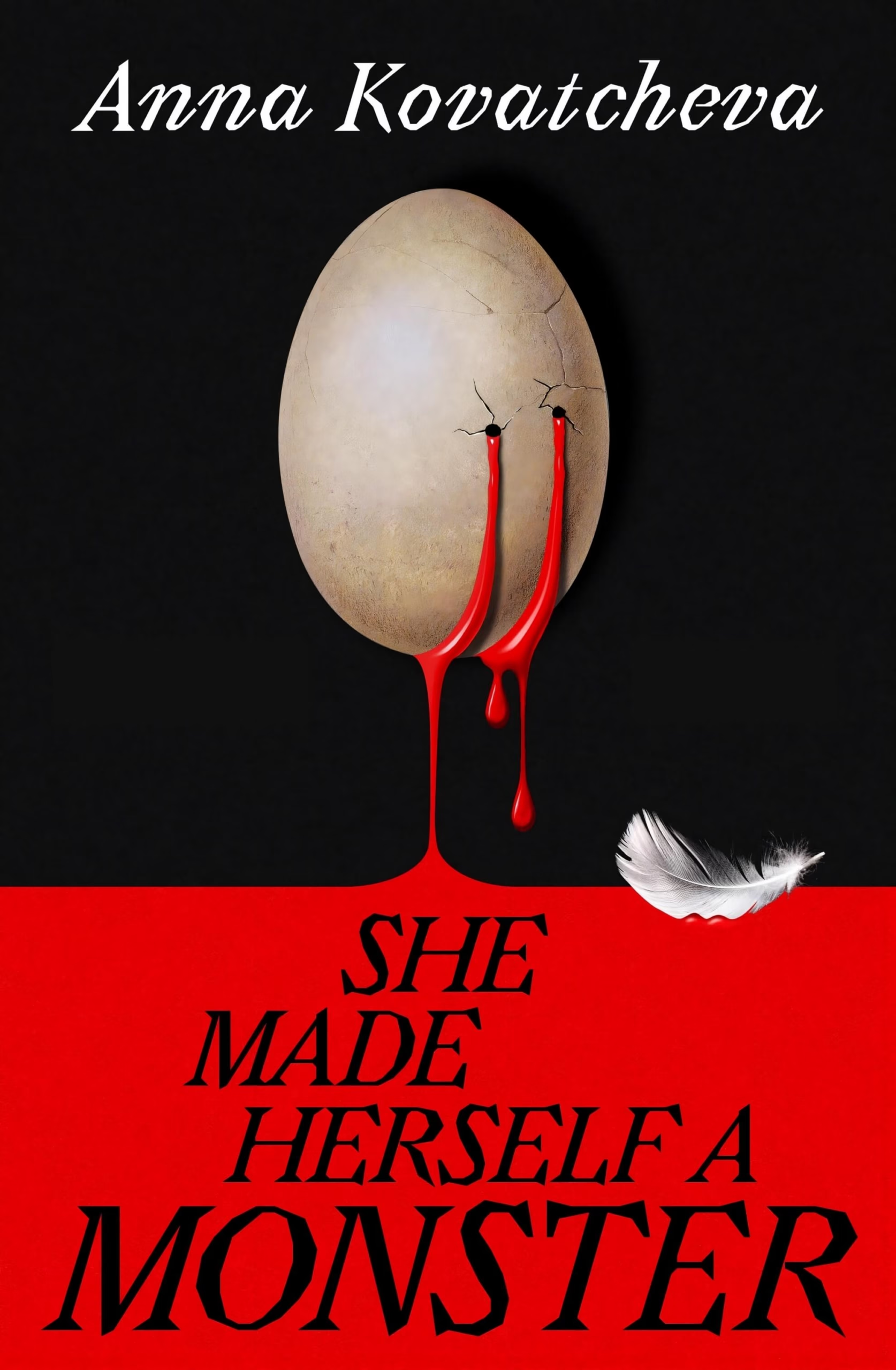
Anna Kovatcheva’s debut reached me through an advance publisher’s list in early 2026, described as a Bulgarian-set folk horror novel with a con artist at its center. The detail that made the premise formally interesting was not the vampire but the fraud: Yana, the novel’s protagonist, rides from village to village staging grisly evidence — animal corpses in public squares, eggs filled with blood left in chicken coops — and then charges the terrified locals to watch her vanquish the creature she planted.
The novel, published by Mariner Books in February 2026, arrived with a starred Publishers Weekly review, blurbs from Jaroslav Kalfař and Julia Fine, and what became an instant New York Times bestseller designation.
My argument is that ‘She Made Herself a Monster’ achieves significant formal power in its first section through exactly this premise — the vampire as manufactured social fiction — and then forecloses the specific kind of dread that the Bulgarian folk horror tradition requires by sustaining that anti-supernatural thesis all the way to the close.
Kovatcheva positions the reader alongside Yana’s fraud from the first page, collapsing epistemological uncertainty before it can generate uncanny weight. The result is a social gothic of genuine intelligence that argues, formally, against the folk horror mode it inhabits.
Not Transylvania, Not Dracula
The distinction between the Bulgarian vampir and the Western Romantic vampire matters formally, not only historically. The Western lineage — from Polidori’s Lord Ruthven through Le Fanu’s ‘Carmilla’ and into Stoker’s count — is a tradition of desire and contamination, a figure whose horror operates through individual charisma and intimate violation.1
The Bulgarian vampir is categorically different: a community designation applied to the recently dead when illness or agricultural failure follows a burial, a social mechanism requiring a named victim, a named slayer, and a communal act of confirmation.
Bulgarian vampire practice included elaborate identification rituals: a nude virgin on a black foal would be ridden through the graveyard, the horse refusing to pass the suspected grave; the creature’s regional designations — vampir, ubour, krvopijac — varied by region and by cause of death.2 What unified them was not supernatural glamour but social function. The creature was, structurally, a diagnosis.
Kovatcheva’s protagonist Yana understands this precisely. Her con depends on the same social logic the folklore encodes: people who need a monster will accept the evidence that confirms one. The novel’s most penetrating formal move is making Yana’s fraud procedurally indistinguishable from the legitimate vampire-slaying ritual it parodies — and that move is only available because Kovatcheva knows which tradition she is working in, and was born into it.
The Con as Formal Device
The novel distributes its narration across multiple points of view — primarily Yana and Anka, the teenage girl she eventually allies with — and the structural choice to lock the reader into Yana’s knowledge in the early chapters is the novel’s most effective formal decision. We watch Yana plant the evidence, then watch the villagers receive it; the gap between what the reader knows and what the community believes generates a specific dread that is not supernatural but sociological. We are not afraid of the vampire. We are afraid of the community.
Kovatcheva’s prose operates in short declarative bursts that resist the elaborate syntactical pressure of Gothic maximalism. Library Journal described the writing as employing “multiple points of view to expose the monsters created to make sense of the shadows” — an accurate description of the structural function.3 The dread comes from precision rather than from tonal diffusion, from the exact physical detail of staged evidence rather than from uncanny distortion of body or landscape.
Yana’s vitiligo — she is brown-skinned with visible depigmented patches, conspicuous in a nineteenth-century Bulgarian village — is not a secondary biographical element but a structural one. Her visible difference makes her simultaneously suspicious and legible to the communities she works: a figure already marked by folk misinterpretation, she weaponizes their tendency to read her body as portent.
In a BookPage interview, Kovatcheva noted that the line Yana’s mother gives her — that people will think things about you, and when they do, you can use their thoughts against you — was present in the earliest draft.4 The novel is, in its formal arrangement, a study of how legibility becomes leverage.
What Forfeiting the Open Door Costs
Folk horror as a mode — from Arthur Machen’s ‘The Great God Pan’ (1894) through Shirley Jackson’s ‘We Have Always Lived in the Castle’ (1962) and into the contemporary global wave — derives its specific force from epistemological openness.
The reader is never entirely certain whether the folk belief is true. The possibility that the ritual might work, that the creature might exist, that the community’s designation might be accurate — this possibility is what gives the folk horror narrative its uncanny weight, its resistance to resolution as social allegory alone.
Kovatcheva closes that door in the novel’s first chapter. Yana is a liar; we know she is a liar; the narrative never questions this. The horror that follows — the plan that takes on a life of its own, as the publisher’s copy describes it — operates in a register of social consequence rather than supernatural possibility.
This is a defensible formal choice: a novel about how communities construct monsters is not obligated to produce an actual monster. But the Bulgarian vampir tradition Kovatcheva inherits is not a tradition of pure social construction. It is a tradition in which the construction was believed, in which the fear was real, in which something was at stake beyond the question of who holds power in the village.
The reader disorientation documented in community responses to the novel — the repeated complaint that the premise overpromises on genre, that the vampire-hunting framing misleads — is not simply an audience-management failure. It points to a genuine formal tension: the novel’s marketing situates it within folk horror, but its structure belongs to social gothic. These are not interchangeable modes. The confusion between them is the novel’s one unresolved argument with itself.
What the Tradition Asks Back
What Kovatcheva has written is a debut of real formal intelligence — one that understands the Bulgarian tradition it draws on well enough to argue with it, and that chooses social clarity over supernatural ambiguity with full awareness of what that choice costs.
I find myself persuaded by that choice through the first half and unconvinced by the second, precisely because the tradition she invokes is one in which the communal and the supernatural were never separable. The Bulgarian vampir was not a metaphor. The novel that most fully inhabits that tradition will not make it one.
When a dark fiction novel situates itself within a specific folkloric tradition but refuses to permit that tradition’s supernatural claims any genuine weight, does it honor the source or deplete it — and does the answer depend on whether the author grew up inside that tradition or outside it?
- Paul Barber, ‘Vampires, Burial, and Death: Folklore and Reality’ (New Haven: Yale University Press, 1988), 26–42. ↩︎
- Jan Louis Perkowski, ‘Vampires of the Slavs’ (Cambridge: Slavica Publishers, 1976), 45–68. ↩︎
- Library Journal, advance review of ‘She Made Herself a Monster,’ 2026. ↩︎
- Anna Kovatcheva, interview, BookPage, February 9, 2026. ↩︎
Leave a Reply