
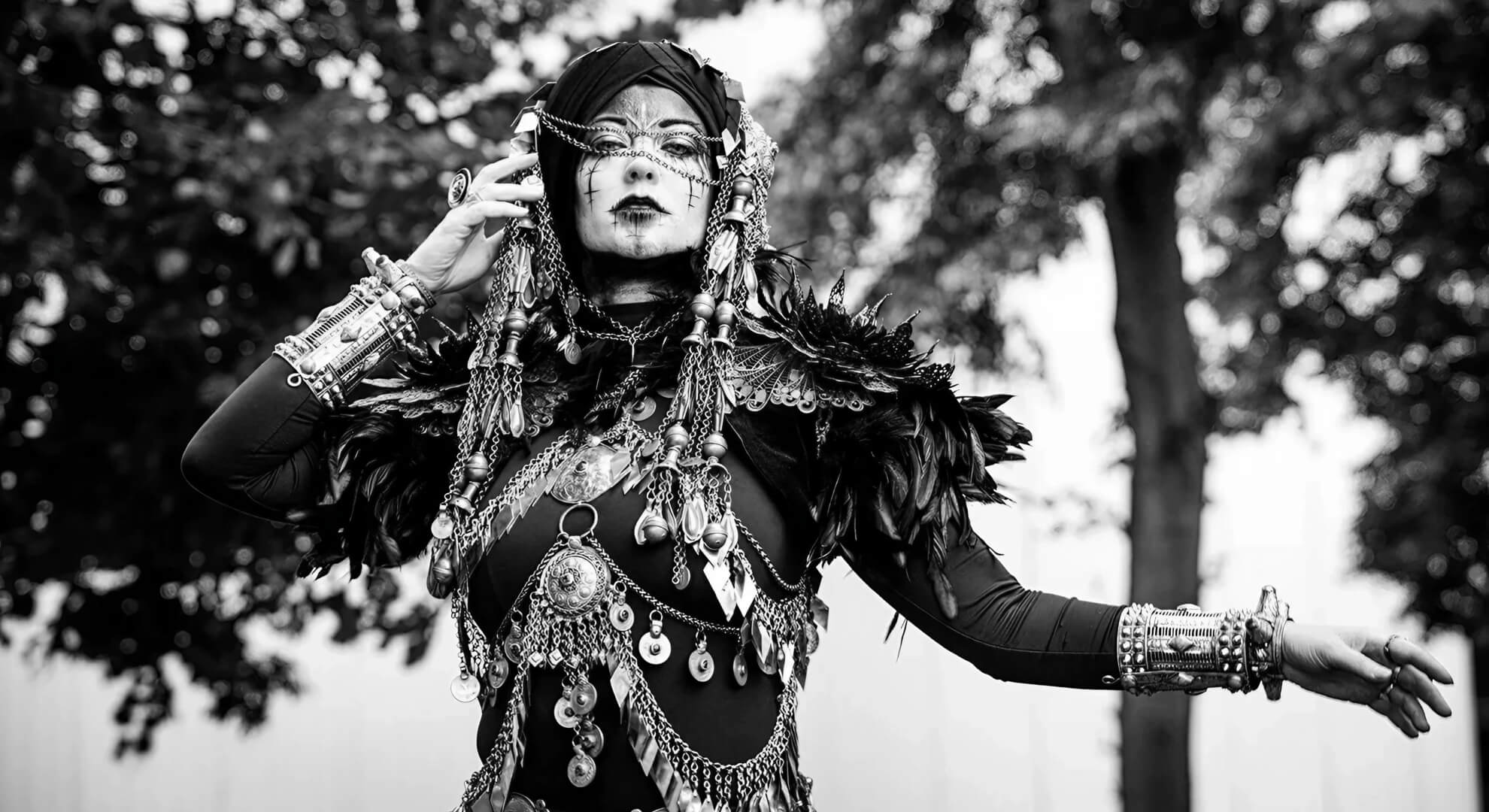


Whitsun weekend in Leipzig has become synonymous with a specific kind of gathering — one that operates outside the logic of the mainstream festival circuit. The announcement of acts for a May festival typically signals bookings chosen to maximize audience reach. The confirmation that Einstürzende Neubauten and Suicide Commando occupy headline positions at Wave-Gotik-Treffen 2026 signals something else entirely: a commitment to the documented history of industrial and EBM music at a moment when those genres risk absorption into broader alternative branding.
The 33rd edition of Wave-Gotik-Treffen takes place May 22 through 25, 2026, across approximately 50 venues throughout Leipzig. Organizers have confirmed over 130 acts, with additional announcements expected in the coming weeks.
The festival draws between 18,000 and 20,000 attendees annually, the majority traveling from Germany, with significant contingents from the United Kingdom, United States, and other European nations.
The Lineup as Historical Document
Einstürzende Neubauten’s inclusion carries weight that extends beyond name recognition. Founded in West Berlin in 1980, the collective established industrial music as something beyond provocation — as a documented method for interrogating sound itself through non-traditional instrumentation, found objects, and structural experimentation.
Their 1981 debut ‘Kollaps’ and 1985’s ‘Halber Mensch’ remain reference points for any discussion of how industrial sound evolved from punk aggression into something formally distinct. The group’s decision to operate outside conventional label structures through the supporter platform system they initiated in 2002 established an alternative model for sustained creative practice that numerous underground acts have since studied.
Suicide Commando performs a 40th anniversary set at the festival. The Belgian act, founded by Johan Van Roy in 1986, positioned itself within the harsher edge of EBM at a time when the genre was splintering into multiple trajectories. Their documented influence on aggrotech and dark electro as subcategories merits recognition separate from their commercial reach.
The inclusion of Frontline Assembly from Canada speaks to the festival’s attention to the North American industrial lineage, while acts such as Deutsch Amerikanische Freundschaft and Das Ich represent the specifically German contribution to electronic body music’s formal development.
Clan of Xymox and Covenant anchor the darkwave and futurepop segments of the bill. The former, active since 1981, operated at the intersection of gothic rock and synthesizer-driven composition during a period when those categories had not yet calcified into separate marketing designations.
Beyond the Headliner Tier
The confirmed roster extends well beyond established acts. She Past Away, the Turkish darkwave duo, represents a geographic expansion of the gothic scene into regions where the subculture developed under different constraints than its Western European counterpart. Their 2012 formation and subsequent European touring demonstrated that gothic music retained currency among younger audiences outside its traditional strongholds.
Molchat Doma from Belarus appears on a bill that historically centered German-language and English-language acts. The trio’s unexpected visibility across Latin America — including documented followings in Colombia’s urban centers — signals how post-punk revivalism has circulated through channels distinct from the festival circuit that sustained it in previous decades.
London After Midnight, the Los Angeles-based gothic rock act founded by Sean Brennan in 1990, makes a rare European appearance. The group’s sporadic release schedule — four studio albums across three decades — stands in tension with their sustained influence, particularly in European markets where gothic rock maintained commercial viability longer than in North America.
Cat Rapes Dog, the Swedish industrial act, celebrates a 40th anniversary alongside Suicide Commando, underscoring the festival’s attention to milestone moments within specific genre lineages. Myrna Loy, another Swedish act, performs an exclusive reunion set.
The appearance of Kim Wilde — a mainstream pop artist whose 1981 single Kids in America achieved international chart success — within a gothic festival lineup warrants attention. Her inclusion suggests either a deliberate curatorial expansion or recognition that segments of the gothic audience maintain connections to new wave’s commercial wing.
The Latin American Gothic Current
The relevance of Wave-Gotik-Treffen to audiences outside Europe requires documentation rather than assumption. Colombia has developed a documented post-punk and darkwave scene centered in Bogotá and Medellín, with acts such as Climas Interiores, Bruma, and Píldora Letal operating within venues like Bar Asilo that have sustained alternative programming.
The circulation of Molchat Doma’s music through Colombian alternative spaces demonstrates how contemporary darkwave travels through digital channels before festival bookings confirm its reach. The band’s presence at Wave-Gotik-Treffen 2026 validates a sonic affinity that Colombian audiences recognized independently of European critical consensus.
Historical precedent exists: Colombian acts CO2 and Frankie Ha Muerto participated in the broader Latin American gothic scene during the 1980s and 1990s, contemporaneous with more visible movements in Mexico and Peru. That lineage has not translated into regular Colombian representation at major European festivals, but the documented existence of a Colombian audience for this music matters independent of booking practices.
The Anti-Festival Model
Wave-Gotik-Treffen operates without a main stage in the conventional sense. Programming unfolds across churches, historic theaters, open-air sites, and underground clubs simultaneously. Attendees construct individual itineraries rather than following a prescribed sequence.
This structure emerged from necessity rather than curatorial vision. The festival began in 1992 as a gathering of approximately 2,000 participants in Leipzig’s post-reunification period, when available venues were scattered rather than consolidated. The city’s infrastructure at that time lacked purpose-built festival grounds.
By 1993, organizational failures nearly ended the event permanently. Financial mismanagement left venues unpaid and performances canceled. The formation of Treffen & Festspielgesellschaft für Mitteldeutschland mbH in the mid-1990s stabilized operations through formal incorporation, securing permits and establishing relationships with Leipzig municipal authorities.
The decentralized format that emerged from those early constraints has since become the festival’s defining characteristic. Where Wacken Open Air consolidated its programming on a single 240-hectare site and Hellfest operates from the Clisson grounds, Wave-Gotik-Treffen distributes its programming across Leipzig’s existing urban infrastructure.
The model creates logistical complexity. Public transportation capacity becomes a limiting factor. Venue capacities vary dramatically — a church performance might accommodate 300 attendees while an Agra hall hosts several thousand. Popular acts fill venues hours before performance times.
That same structure prevents the festival from becoming a singular spectacle. Attendees who prioritize neofolk acts experience a different event than those focused on EBM club nights or gothic metal performances. The absence of a unified audience gathering creates space for subgenre specificity that larger festivals compress into undifferentiated alternative programming.
The Victorian Marketplace and Pagan Village
Wave-Gotik-Treffen includes programming that extends beyond musical performance. The Agra fairgrounds host a medieval market and pagan village that operate throughout the four-day period. Victorian picnics with period attire and chamber music ensembles occur in Leipzig’s parks.
These elements position the festival as cultural reenactment as much as music event. The attention to historical aesthetics — whether Victorian, medieval, or pre-Christian — reflects gothic subculture’s documented relationship to romanticized pasts as sites of resistance to industrial modernity.
The marketplace functions as the largest annual gathering of gothic fashion vendors, accessory makers, and specialized retailers in Europe. For participants, attendance serves economic purposes alongside social and musical ones.
Ticket Access and Festival Economics
The four-day festival ticket costs 190 euros (approximately 222 dollars), with an additional eight-euro (approximately nine dollars) handling fee. The Obsorge ticket, which grants camping access, adds 50 euros (approximately 59 dollars). Parking passes cost 20 euros (approximately 23 dollars), while caravan parking requires 150 euros (approximately 176 dollars).
The festival ticket includes access to Leipzig’s public transportation system from Friday morning through Tuesday afternoon, addressing the logistical demands of the decentralized venue structure. Without this provision, transportation costs would accumulate across multiple venue changes per day.
Capacity limitations at individual venues mean that ticket purchase guarantees festival access but not entry to specific performances. Popular acts regularly reach capacity before set times. The festival program book, distributed at ticket exchange points, provides venue capacities and running orders.
The Cemetery at the Battle Site
Südfriedhof occupies 82 hectares in southern Leipzig, positioned in the immediate vicinity of the Völkerschlachtdenkmal monument. The cemetery opened in 1886 on land where the Battle of Leipzig had occurred in October 1813. More than 90,000 soldiers died during that three-day engagement between Napoleon’s forces and the armies of Russia, Prussia, Austria, and Sweden.
The cemetery’s design, executed by city planning director Hugo Licht and municipal garden director Otto Wittenberg, follows a layout shaped like a linden leaf — a reference to Leipzig’s Slavic name meaning the place where the lime trees stand. More than 560,000 Leipzig residents have been interred there since its founding.
The crematorium complex, completed in 1910 under the direction of architect Otto Wilhelm Scharenberg, centers on a 60-meter bell tower visible from considerable distance. The neo-Romanesque structure was modeled on Maria Laach Abbey and remains the largest cemetery monument in Germany. The facility includes chapel buildings, columbarium, and surrounding funerary halls.
Memorials within the grounds commemorate anti-fascist resistance members executed during the Nazi period. A separate memorial section contains the remains of 3,474 individuals killed during Allied bombing operations against Leipzig in World War II.
Grave monuments include work by sculptors Max Klinger, Carl Seffner, and Fritz Behn. Notable interments include dialect poet Lene Voigt and members of the Baedeker publishing family. The grounds function as public parkland, with walking paths through sections planted with ginkgo trees, sweetgum, and varieties of rhododendron that reach four meters in height.
The 33rd Wave-Gotik-Treffen proceeds from a position of institutional stability rare within subcultures that prioritize anti-commercial positioning. Three decades of operation have established organizational knowledge and municipal relationships that allow programming complexity impossible for newer events. That stability permits curatorial choices oriented toward genre specificity rather than audience expansion.
The presence of acts celebrating 40-year careers alongside contemporary darkwave projects documents how gothic and industrial subcultures have sustained themselves across generational transitions. Whether that documented history translates into continued relevance for audiences encountering these sounds in 2026 remains the question the festival itself must answer through its attendance and reception.
Leipzig in late May offers one concentrated opportunity to observe what remains of the gothic and industrial movements after decades of subcultural drift and commercial appropriation. The lineup suggests organizers believe something worth preserving persists within those categories beyond nostalgic reenactment.
Leave a Reply