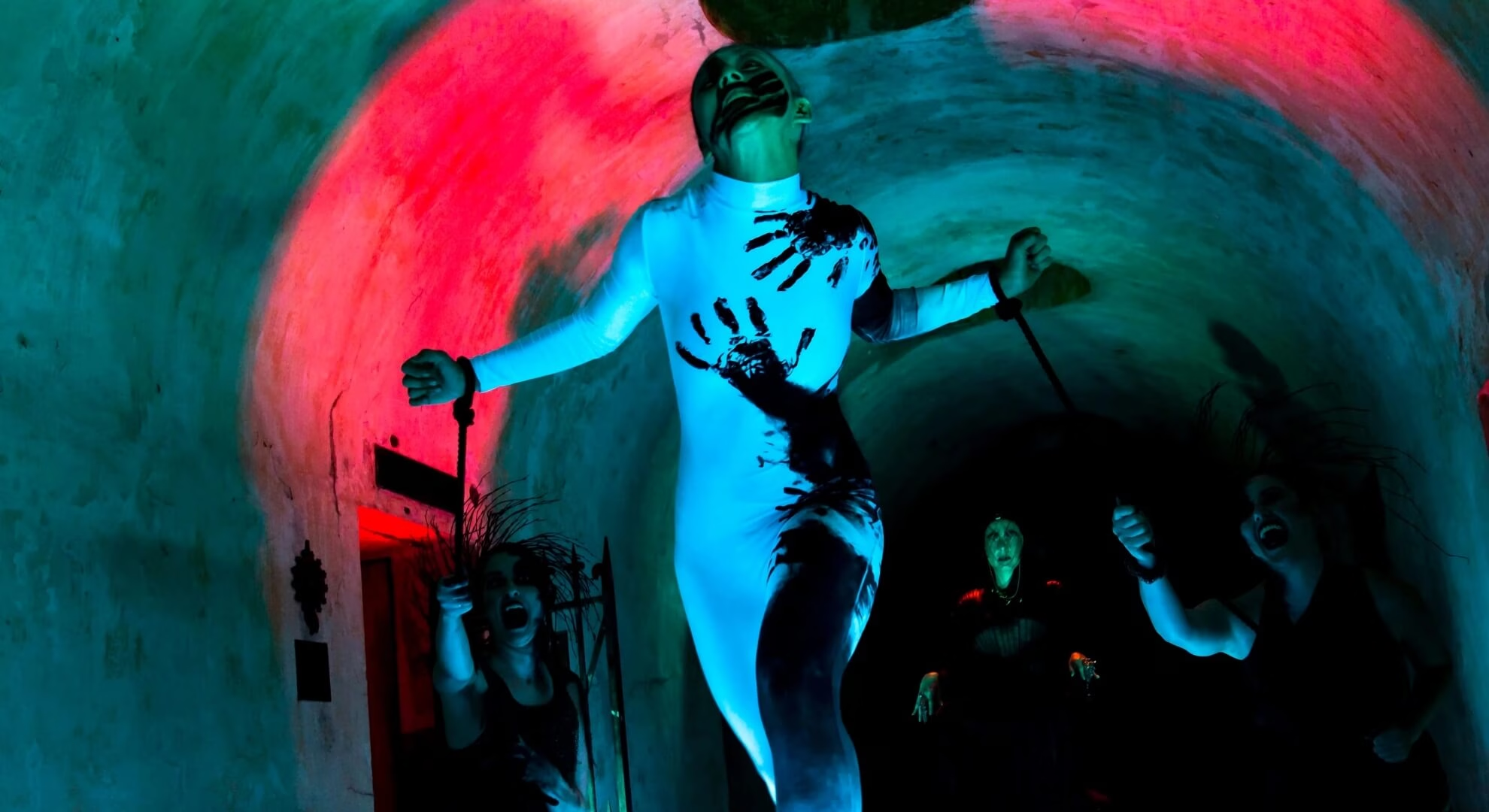


On an October night in 2025, two thousand people moved through the moonlit paths of Green-Wood Cemetery in Brooklyn — encountering musicians stationed beneath weeping beeches, dancers positioned at the base of mausoleums, circus performers silhouetted against nineteenth-century granite, and film projections cast against the cemetery’s neo-Gothic chapel facade.
‘Nightfall,’ produced by Death of Classical founder Andrew Ousley in partnership with Green-Wood, Rooftop Films, Morbid Anatomy, and Bindlestiff Family Cirkus, is a three-hour non-linear outdoor experience; it is also, as Ousley has demonstrated across multiple seasons of programming in burial grounds, the most current iteration of a function these cemeteries were designed to serve.
The First Parks Were Graveyards
Before Central Park existed, before the urban park movement had given American cities any green public space at all, New Yorkers went to Green-Wood Cemetery for recreation.
Incorporated in 1838 on 478 pastoral acres of rolling Brooklyn hills and designated a National Historic Landmark by the United States Department of the Interior, Green-Wood was designed not merely as a place of interment but as a public destination — for carriage rides along its winding paths, for viewing the monumental sculpture that wealthy families commissioned for their plots, for the kind of pastoral respite that the overcrowded streets of a rapidly industrializing city could not provide. By the mid-nineteenth century, the cemetery drew more than 60,000 visitors annually, making it one of the most attended cultural destinations in the country.
This was not an accident of Green-Wood’s character. It was the explicit intention of the Rural Cemetery Movement, the American cultural and civic project that produced Green-Wood, Mount Auburn in Cambridge, Massachusetts — the first of the new-model cemeteries, opened in 1831 — and dozens of comparable grounds across the following decades.
Historian Stanley French, writing in American Quarterly in 1974, documented how these cemeteries functioned as “the cultural institution” of their era: not passive receptacles for the dead but active public spaces whose founders understood them as moral and aesthetic destinations, sites of civic communion.
When the English actress Fanny Kemble visited Mount Auburn two years after its opening, she described it as “a pleasure garden instead of a place of graves.” A Swedish visitor was reported to have observed that a single visit “almost excites a wish to die” — which, in context, read less as a morbid confession than as a tribute to the grounds’ beauty.
The garden designer Andrew Jackson Downing made the connection between these cemeteries and the city’s civic need explicit: “In the absence of public gardens,” he wrote, “rural cemeteries in a certain degree supplied their place.” The movement had its roots in Paris, specifically in the Père Lachaise Cemetery, which opened in 1804 as a deliberate reimagining of the burial ground as a public garden, landscaped in the English style with curving paths and naturalistic plantings.
Mount Auburn’s founders studied it directly. When the movement produced Green-Wood, they inherited and extended that model, designing a ground whose pathways assume an ambulatory, exploring visitor — someone who came not only to mourn but to walk, to observe, to spend time among the living and the dead in a specific, acknowledged proximity.
That function was not indefinitely sustained. As urban parks emerged in the second half of the nineteenth century — Central Park, which Frederick Law Olmsted acknowledged was directly inspired by the cemetery model, opened in 1858 — the recreational and cultural dimension of burial grounds was absorbed elsewhere.
Twentieth-century attitudes toward death pushed cemeteries further from civic life, rendering them solemn, restricted, and socially quarantined. Green-Wood’s Victorian Gothic Revival gateway, designed by Richard Upjohn and completed in 1861, became an entrance to a site that fewer and fewer New Yorkers visited for any reason other than burial. What Andrew Ousley and a small number of practitioners at documented sites in New York and London are doing now is, in this light, less a transgression than a restoration.
What the Stone Does to Sound
The catacombs beneath Green-Wood Cemetery were constructed in the 1850s, cut into the glacially deposited hillside that gives the grounds their distinctive rolling contour. The chambers are arched, lined with stone, and designed to receive the remains of those whose families preferred a sealed vault to an earthen plot.
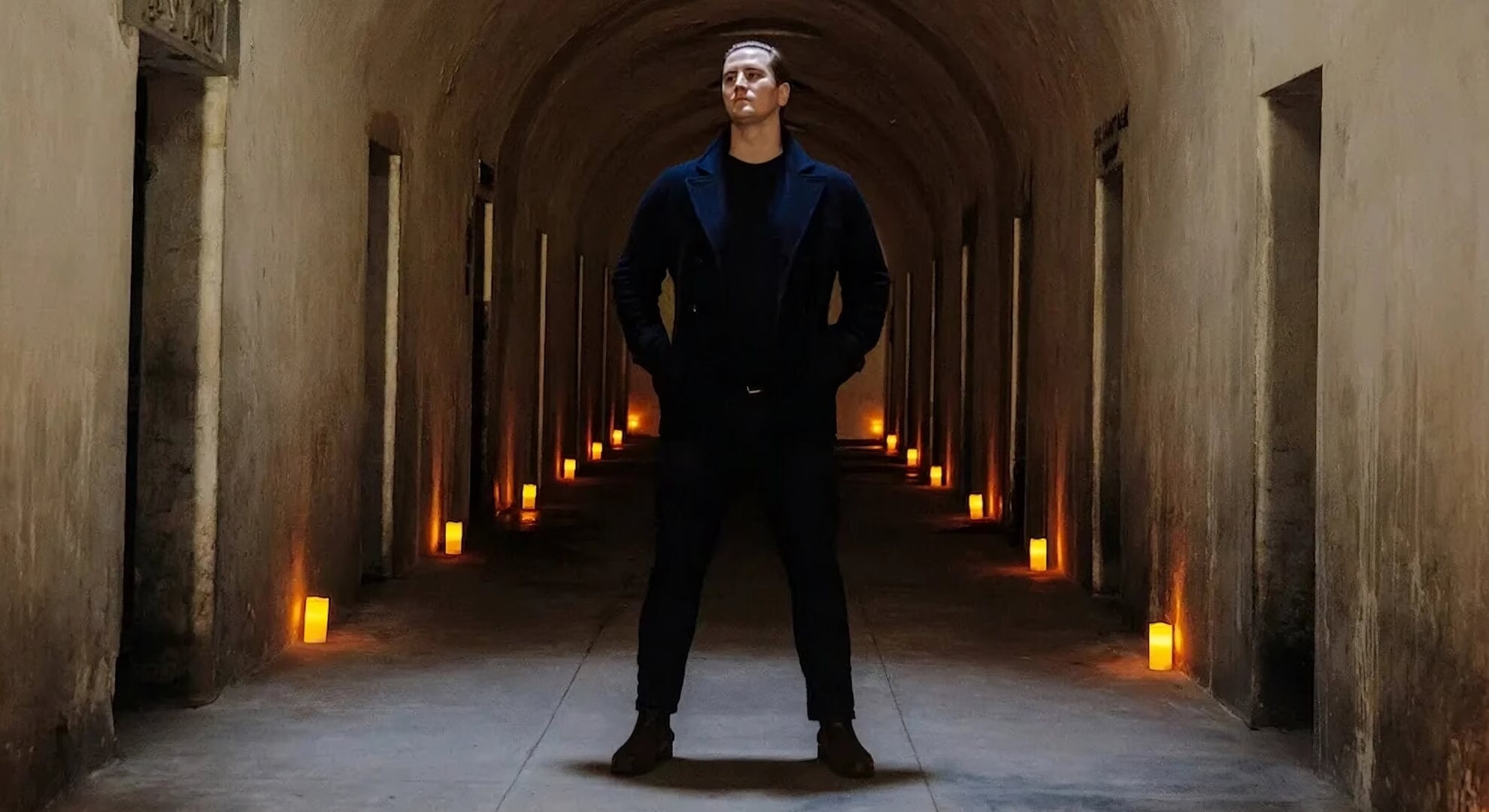
They are also, as Andrew Ousley discovered when he began programming classical music and opera there, an extraordinary acoustic environment. “We are obviously not setting the music in Carnegie Hall, or even your average proscenium theater with a nice green room,” Ousley noted in a 2025 interview with Chamber Music America. “It is literally a crypt and catacomb and a cemetery.”
Ousley founded Death of Classical as a nonprofit dedicated to presenting intimate classical and opera performances in unusual spaces. Its two flagship series — ‘The Crypt Sessions,’ staged in the crypt under the Church of the Intercession, a Gothic Revival church in Harlem, and ‘The Angel’s Share,’ now in its sixth season in Green-Wood’s catacombs and grounds — have drawn sustained critical attention.
The New York Times placed ‘The Crypt Sessions’ among its top classical concerts of the year, writing of one performance that the music, in the sacred space, “sounded like a forlorn benediction,” and noting plainly: “In a Cemetery, music lives.” Vogue called ‘The Angel’s Share’ “one of the most riveting and unusual chamber music performances of my lifetime.” Both descriptions locate the critical charge in the specific encounter between music and burial space, not simply in either element alone.
‘The Angel’s Share’ takes its name from the distiller’s term for the portion of a whiskey barrel’s contents that evaporates during aging — the share that goes to the angels. Each concert includes a pre-performance spirits tasting, positioning the audience as participants in a kind of secular ritual before the music begins.
The programming spans medieval to contemporary works, chosen to highlight the acoustic properties of the catacombs and the character of the grounds. When the composer Dave Malloy performed his ‘Ghost Quartet’ at Green-Wood — a work Malloy has described as “a song cycle about love, death, and whiskey” — the correspondence between themes and setting was not incidental but argued.
The same logic governed ‘The Angel’s Share” performance of Henry Purcell’s ‘Dido and Aeneas’ in the catacombs: an opera whose subject is grief and departure, performed in a place where grief and departure are the constitutive facts of the ground.
‘The Crypt Sessions,’ meanwhile, has been the site of world premieres: the opera ‘The Rose Elf’ by David Hertzberg, directed by R.B. Schlather, and a performance by the Attacca Quartet of Caroline Shaw’s string quartet works — the same ensemble and repertoire that won the 2020 Grammy for Best Chamber Music/Small Ensemble Performance.
That programming of this caliber actively chooses burial spaces over conventional concert halls is not novelty but a specific and consistent claim: that the proximity to mortality intensifies the act of listening, and that the space’s acoustic and historical properties are not background conditions but co-authors of the experience.
In a 2020 interview with the Brooklyn Rail, Ousley stated his core intention directly: “To me it is not just a concert as it is an entire experience.” The experience he describes is not theatrical novelty — not the spectacle of candlelight and carved stone — but a totality in which the audience’s awareness of where they are becomes part of what the music means. The people buried in Green-Wood’s catacombs are not a backdrop; they are the condition under which the music is heard.
Naming the Unnamed
On the West side of Highgate Cemetery in London, there is an unmarked grave containing the remains of ten women and girls. For more than a century, their identities were lost — recorded not in public memorial but in institutional silence. They had been residents of the Highgate Penitentiary, a Victorian institution known as “The House of Mercy,” and they died there, most of poverty and illness. The youngest was fourteen years old.
In September 2025, Theatre in the Square, a North London drama company, performed ‘The Lost Girls of Highgate Cemetery’ to a sell-out audience in Highgate’s courtyard, staged on the cemetery grounds where the ten women were buried. The production was directed by Danielle Flower, with archival historical research by Richard Kuhn, and drew on contemporaneous accounts and institutional records to reconstruct the lives of the women the Highgate Penitentiary had confined. The play returned for a longer run in Summer 2026, also at Highgate, after its initial run sold out entirely.
What ‘The Lost Girls of Highgate Cemetery’ performs, by staging in the cemetery rather than a conventional theatre, is something that could not be replicated in a purpose-built venue. The burial ground is not a scenic choice; it is the evidentiary site. Flower, speaking at a public talk at Lauderdale House in North London, described the production’s work as “honoring the names of women often lost to time.”
The cemetery makes that honoring a physical act: the audience stands on the same ground where these particular women are buried, which transforms the act of naming them from theatrical representation into documented public witness. Christina Rossetti, Theatre in the Square notes, served as a volunteer at the Highgate Penitentiary; the question the production poses — whether the “Lost Girls” might have informed her poetry — is one that can only be fully asked in the place where their physical traces remain.
Highgate Cemetery, established in 1839, was itself part of the Victorian Gothic Revival project that shaped English burial grounds throughout the nineteenth century. Its Egyptian Avenue, designed in the neo-Egyptian Revival style, and its Circle of Lebanon — a circular arrangement of mausoleums built around what was once a 230-year-old cedar tree — were conceived as monuments to the Romantic aestheticization of death, as spaces where the living would find beauty in proximity to the grave.
The Friends of Highgate Cemetery Trust, established in 1975 after years of neglect and vandalism that closed the West Cemetery, has maintained the grounds as what its documentation describes as a “controlled wilderness” — overgrown, ivy-reclaimed, the stone seeping into the surrounding flora rather than standing apart from it.
Theatre in the Square’s decision to perform in that courtyard activates the dormant civic meaning of that maintenance: the decision to preserve a Victorian burial ground is also, as it turns out, the decision to preserve a space where performance can address history directly.
Nightfall and the Plural Stage
‘The Angel’s Share’ and ‘The Crypt Sessions’ operate on the model of the intimate concert — small audiences in architectural enclosure, the concentrated attention that proximity to burial chambers tends to produce. ‘Nightfall,’ the annual large-scale event that Death of Classical produces with Green-Wood, Rooftop Films, Morbid Anatomy, and Bindlestiff Family Cirkus, works from an entirely different premise.
Two thousand people moved through Green-Wood’s grounds during ‘Nightfall’ 2025, encountering a non-linear distribution of performances across 478 acres of terrain in near-darkness. Musicians, dancers, storytellers, circus performers, and film projectionists were stationed at specific sites throughout the grounds.
There was no single stage, no fixed viewing position, no sequential program. The audience navigated the cemetery in darkness, discovering performances rather than being seated before them.
This structure — non-linear, ambulatory, site-specific — reactivates the original spatial logic of the Rural Cemetery Movement’s design. The winding paths, the rolling terrain, the deliberate asymmetry of grounds like Green-Wood — all the features that nineteenth-century designers built into these places to provide what Andrew Jackson Downing called an alternative to the “frenetic confines of the city” — become, under ‘Nightfall’’s conditions, a choreographic environment.
The cemetery’s design assumes a moving, exploring visitor. ‘Nightfall’ takes that assumption seriously and programs it explicitly, distributing performance across the ground as though reactivating a spatial grammar the grounds already contain.
The range of ‘Nightfall’’s co-producers is itself an argument. Morbid Anatomy, the Brooklyn-based organization that combines death studies, art history, and dark cultural research, brings documentary seriousness; Rooftop Films has built its practice on the premise that unconventional outdoor spaces are legitimate cinematic environments; the Bindlestiff Family Cirkus has performed at Green-Wood across multiple seasons.
What ‘Nightfall’’s producer list describes is not a single aesthetic but a convergence of distinct practices that Green-Wood’s scale and character can accommodate simultaneously — proof that the nineteenth-century park-cemetery was designed with enough ambition to sustain forms of cultural life that its Victorian planners could not have anticipated.
Death of Classical extended its programming to the Cathedral Church of St. John the Divine in 2024–2025, partnering with Trinity Church’s contemporary music ensemble NOVUS on a series of thematic programs in the cathedral’s crypt. The expansion demonstrates that Ousley’s model is not specific to Green-Wood but portable to any space whose relationship between the living and the dead can be made productively present in performance.
What Green-Wood, the Church of the Intercession, and the Cathedral of St. John the Divine share is the Gothic Revival tradition that connects American ecclesiastical design to its nineteenth-century European sources — pointed vaults, stone enclosure, the sensory conditions that position the body against age and permanence and the accumulated weight of the lives that have passed through them.
The Infrastructure of the Dead
In a 2022 interview with Brooklyn Magazine, Andrew Ousley articulated the proposition his programming has consistently demonstrated: “The art form, the music, is immortal. This is timeless music. People say, ‘Classical music is dead.’ And it is not classical music. It is the infrastructure around it.”
The observation is, in one reading, a comment on concert hall culture, on the conservatism of institutional classical music presentation. But in the context of Ousley’s specific practice — staging performances in burial grounds — it carries a further charge. The infrastructure that has failed classical music is precisely the formal neutrality of the purpose-built concert hall: its studied blankness, its declaration that music happens in a space from which the world’s complications are excluded.
The crypt and the catacomb and the cemetery are the opposite: spaces dense with the evidence of mortality, with the accumulated weight of the lives that ended in them. When music happens there, the infrastructure is not neutral. It is the condition.
This is what connects Ousley’s chamber music programming to Theatre in the Square’s documentary performance at Highgate, and both to the original nineteenth-century civic function of the garden cemetery. All three practices understand the burial ground as a place where the living and the dead coexist in a specific, non-metaphorical sense: the dead are there, in the ground, in the catacombs, in the unmarked graves.
The performances do not aestheticize that fact; they work with it. The audience at ‘The Angel’s Share’ is seated above the remains of New Yorkers from the 1850s. The audience at ‘The Lost Girls of Highgate Cemetery’ stands on the same ground as the ten women whose names the production attempts to restore. These conditions are not incidental to the work; they are what the work is about.
The Rural Cemetery Movement understood something that twentieth-century burial practice largely forgot: that the proximity of the living to the well-maintained remains of the dead is not destabilizing but civic — a managed relationship to mortality that cultures across recorded history have organized differently but have rarely, until modernity, entirely removed from public life.
Stanley French’s documentation of the nineteenth-century garden cemetery as a “cultural institution” is not merely an observation about past aesthetic preference; it is a record of what a cemetery can do when it functions as a space of public life rather than a space of private grief, walled from the city’s commons. The programming at Green-Wood and Highgate is not importing a foreign function into a hostile space. It is restoring the ground to a capacity it was deliberately designed to hold.
The Dead Do Not Require Silence
The evidence accumulating across Green-Wood’s catacombs, the Church of the Intercession’s crypt, and Highgate Cemetery’s West side courtyard points to a specific and documented development: practitioners working with burial grounds are not staging ironic inversions of the cemetery’s function but recovering a civic capacity that these spaces were designed to hold.
They are returning to places whose original purpose — as the first public parks, as the first civic arts destinations, as the spaces in which the nineteenth century worked through its understanding of mortality and commemoration in shared public life — was never erased by the nature of burial grounds themselves, only displaced by the rise of the urban park and the twentieth century’s progressive withdrawal of death from public culture.
What Andrew Ousley has demonstrated across multiple seasons in Green-Wood’s catacombs is that the acoustics of a burial vault are different from those of a concert hall in ways that matter to music, and that an audience seated above the remains of mid-nineteenth-century New Yorkers hears differently. What Theatre in the Square demonstrated at Highgate is that staging a performance where the dead whose story it tells are actually buried makes that performance something other than historical drama.
These are documented claims about what specific spaces do to specific cultural practices — and about what those practices do, in return, to the grounds that hold them. The stone is not a backdrop. The programming that has begun to happen inside it is the cemetery recovering its original voice.

Leave a Reply