

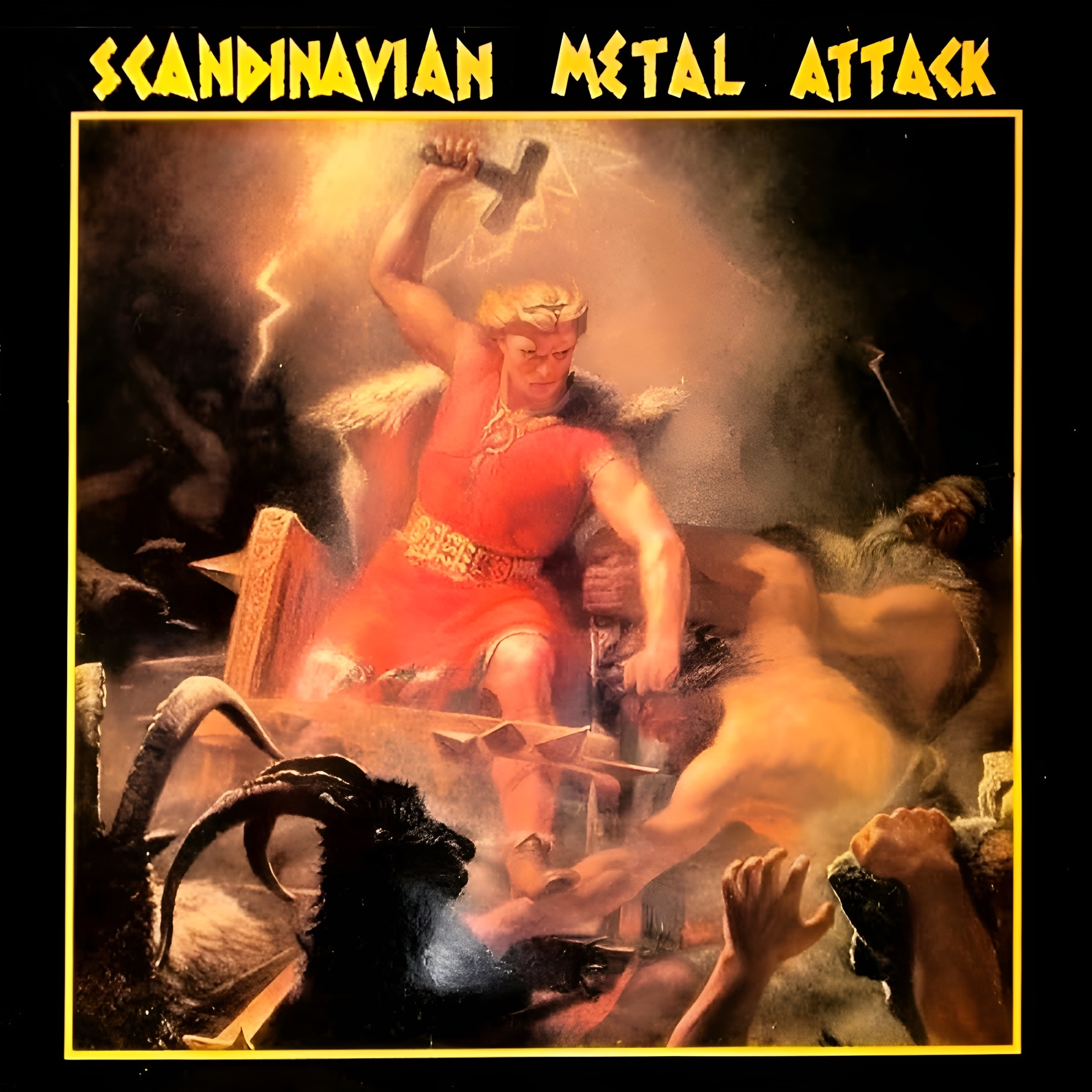
The painting on the front of ‘Scandinavian Metal Attack’ was 112 years old when Tyfon Grammofon printed it on a record sleeve in Stockholm in 1984. Mårten Eskil Winge had shown ‘Tors strid med jättarna’ (‘Thor’s Fight with the Giants’) at the Nationalmuseum in 1872: a blond thunder god in a goat-drawn chariot, hammer raised against a crowd of giants.
Behind that image sat 10 tracks of English-language heavy metal by five bands. Two of them came from Finland, and a third, from the Swedish town of Katrineholm, was made up of musicians with Finnish surnames. None of the 10 titles refers to Norse myth.
Four years later Bathory, the youngest act on the record, put a Norwegian Romantic painting of Odin’s wild hunt on ‘Blood Fire Death’ and began the turn that metal history treats as the start of the Nordic in metal. The 1984 sleeve tells a different story. The image came first, a record label chose it, and the record it wrapped has been remembered for two of its 10 tracks.
Where the Nordic Story Starts
Scholarship on Nordic metal identity has a fixed point of origin, and that point is Bathory. Imke von Helden’s chapter, which borrows the compilation’s title for its own, follows the power of the North in extreme metal from Bathory into black and death metal and then into the smaller subgenres of Viking and pagan metal.1
Simon Trafford and Aleks Pluskowski treat the Viking of hard rock and heavy metal as a modern medievalist figure, a costume the genre picked up and rearranged2, while Trafford later devoted a chapter specifically to Bathory and what he calls the birth of Viking metal, with ‘Blood Fire Death’ (1988) as its hinge.3
Karl Spracklen reads the folk and Viking metal that followed as a field of fantasy about drinking, fighting, and invented patriarchs, and argues that it carries a hegemonic white masculinity.4 The most recent work continues on the same path.
Shane Hawkins and Timothy Pettipiece’s 2024 study of Thor in metal takes its primary examples from ‘Hammerheart’ (1990) and from Týr, and closes on Viking metal’s debts to German Romanticism and the Völkisch movement.5 Annika Christensen’s study of Faroese “kvæði” (ballads) in Viking metal pushes the inquiry toward folk sources but stays within the same post-1990 repertoire.6
This literature agrees on its starting date because it is organized around lyrics, imagery, and ideology, and those three things change on Bathory’s records between 1987 and 1990. Before that, the Nordic in metal registers in the scholarship only as a place of origin, not yet as a subject. The 1984 compilation appears in it twice: once as a borrowed title and once as the record on which Bathory first appeared. Neither appearance examines the record itself.
The Finnish side of the history is organized differently. Toni-Matti Karjalainen and Eero Sipilä describe the internationalization of Finnish heavy metal as a national story told in phases, beginning with the early 1980s, and follow how the domestic press lifted some bands and dropped others before a recognizable Finnish metal brand emerged.7
Karjalainen’s later work on what he calls sounds of origin argues that coverage of Nordic bands habitually supplied stories about nature, weather, and national mentality, and attached them to the music after the fact.8 That framework comes closest to the problem this essay addresses, but it treats the country of origin as the unit of analysis.
A Swedish label packaging Finnish and Swedish bands under a Swedish painting, and selling the result as “Scandinavian,” falls between the national Finnish history and the Nordic-identity literature, and neither has examined it.
The gap is therefore specific. The record’s sleeve, its eight non-Bathory tracks, and the Finnish musicians who made a majority of its music have not been treated as historical evidence. Treated as evidence, they move the origin of metal’s Nordic image back four years. They also relocate it from a musician’s bedroom to a label office, and show that it was attached to a body of music with no Nordic content.
A Replacement on the Running Order
Tyfon Grammofon was a small Stockholm label run by Börje Forsberg, who produced every track on the compilation under the credit “The Boss.” The record came out in the first quarter of 1984. Sources disagree on the exact date: some release listings give January 19th, while other chronologies give March.
The Swedish issue carried the catalog number WAVE-LP-8008. RCA licensed it for the rest of Europe as NL70355, and further pressings appeared in Spain and Greece the same year. According to the sleeve, every title was recorded and mixed at two Stockholm facilities, Electra Studio and Stockholm Recording. The licensing history matters here because it shows how far the Winge image traveled before any Viking metal existed. The same painting sat in German, Spanish, and Greek record shops in 1984 above music that had nothing to do with it.
Bathory was on the record by accident. Daniel Ekeroth’s history of the Swedish scene documents that Quorthon, Forsberg’s son, worked part-time at Tyfon while the compilation was being assembled. When one of the planned bands withdrew, the label let Bathory take its place.
The trio recorded ‘Sacrifice’ and ‘The Return of the Darkness and Evil’ for the compilation in January 1984. Those two recordings are the band’s first appearance on record, and the fan mail that followed led Tyfon to commission the self-titled debut that summer.
The sequencing is a curatorial document in its own right. Side A ran Oz, Trash, Bathory, Spitfire, and Zero Nine. Side B returned to all five in a new order and closed with Bathory’s ‘The Return of the Darkness and Evil.’ Each band received two tracks, and none was given priority. The record presented a roster rather than a headliner, and the only thing it asked the five acts to share was a regional label printed above a national-romantic painting.
Since 1984, the record’s reception has reversed its own logic: the replacement band became the reason anyone hears the record, and the four acts that were the original plan have been reduced to the opening acts on Bathory’s first appearance.
Thor Above the Track List
Winge’s painting is a museum object with a documented history, and the Nationalmuseum’s own catalog account explains why it suited a sleeve.
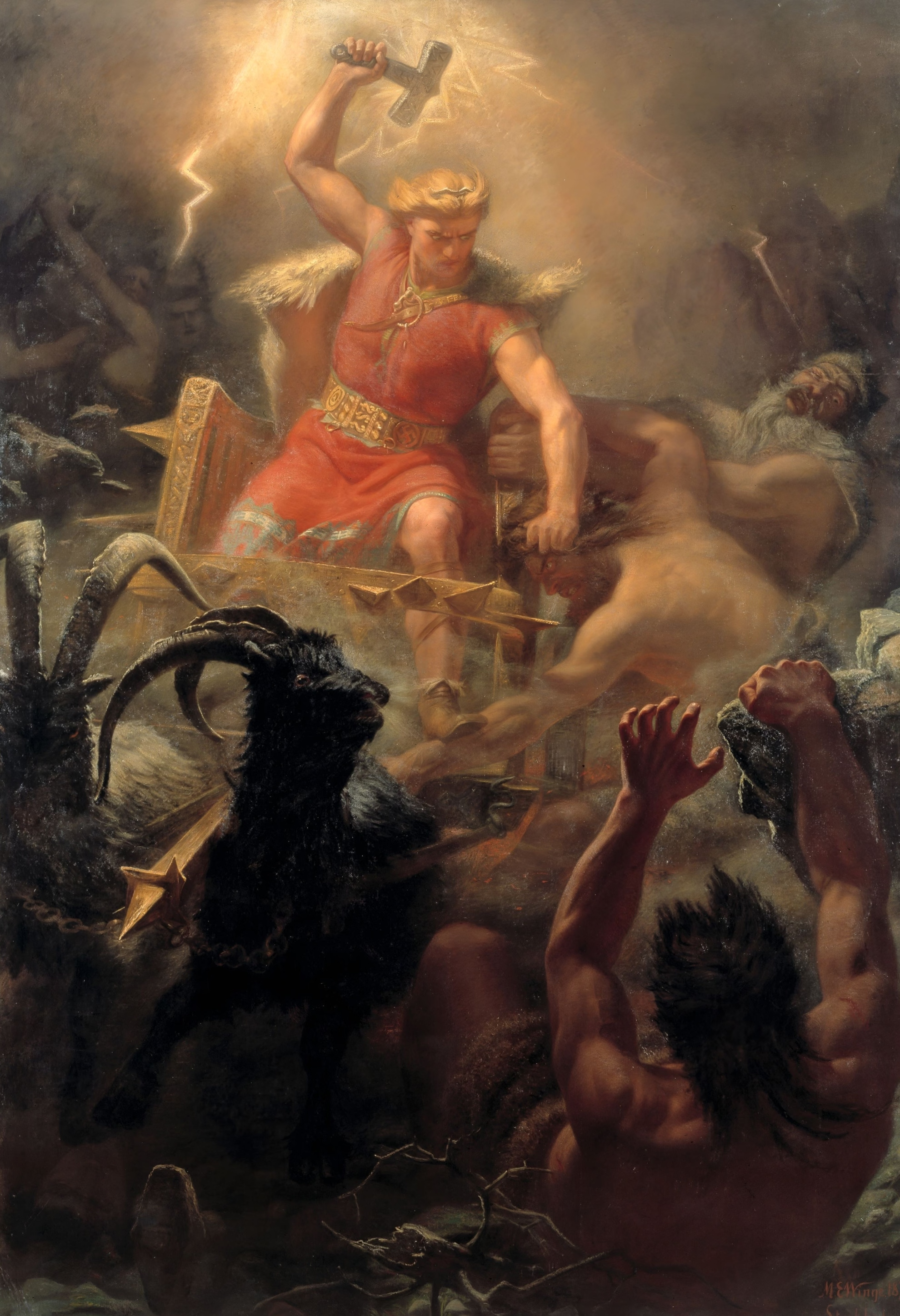
The canvas, completed in 1872 and held as NM 1250, shows Thor in the full equipment the Prose Edda assigns him: the hammer Mjölnir, the strength belt Megingjörð, and the chariot pulled by the goats Tanngnjóstr and Tanngrisnir.
The museum situates the work in a decade when many Scandinavian artists were painting the Æsir and when Norse myth was broadly popular. It records that Winge’s first audience saw a general allegory of good against evil, and that modern viewers have read the blond Thor against the dark-haired giants as an expression of nationalist or fascist ideals.9
Tyfon therefore took a Swedish national-romantic image, already carrying a contested political reading, and set it over a roster that was not exclusively Swedish. The title did the same work in words. In the strict regional sense, Scandinavia means Denmark, Norway, and Sweden; Finland belongs to the wider Nordic group but not to that core.
Von Helden had to state explicitly that her “North” included Finland, which shows how readily the narrower term absorbs it. The 1984 record absorbed two Finnish bands into “Scandinavian” and placed them under a Swedish Thor, at a time when Finnish national romanticism had its own repertoire. Elias Lönnrot compiled the ‘Kalevala’ in 1835 and expanded it in 1849, and Akseli Gallen-Kallela had painted its heroes in the 1890s. Neither the epic nor that tradition appears anywhere on the package.
This is the core of the intervention. The scholarship treats the Nordic turn in metal as something musicians did: Quorthon reading mythology, Enslaved choosing Old Norse, Týr setting Faroese ballads.
The 1984 sleeve shows that before any musician made that choice, the label had already printed the Nordic image on a record. It came as packaging and was later adopted as content. The painting predicted nothing about the music inside. It was the frame through which a small label offered a regional roster to German and Spanish buyers, and it was chosen by the producer whose son would turn the frame into a style four years later.
Finnish Hands, English Names
Oz formed in Nakkila, in western Finland, in 1977, and moved its base to Stockholm in 1983, the year before the compilation, while Zero Nine formed in 1978 in Kuusamo, near the Finnish border with the Soviet Union, and had released its debut album, ‘Visions, Scenes and Dreams,’ in 1982. Its six-member lineup on the compilation included a keyboard player, Iro Murtola, alongside two guitarists.
Spitfire came from Katrineholm, in Södermanland, and was credited as Kimmo Morja on vocals, Rauno Morja and Reijo Väliaho on guitars, and Jarmo and Jouni Heikkinen on bass and drums. Trash and Bathory were the Swedish contingent.
Counted by credited musician rather than by band, the Finnish bands and the Finnish-surnamed Katrineholm group supplied a clear majority of the people who played on ‘Scandinavian Metal Attack.’
None of them presented a Nordic identity. The compilation’s credits and its bands’ own releases are full of English stage names. Trash’s members appear as Tony Roy Taylor, Gene Ball, and Mike Mocadem; Spitfire’s own releases used anglicized names; Quorthon used the alias Ace Shoot in this period; and Oz’s members also performed under English-language stage names.
Every title on the record is in English. In 1984, these musicians wanted to sound like the transatlantic heavy metal of the New Wave of British Heavy Metal and its American counterparts, not like the North.
Zero Nine’s singer has described this tension directly. Speaking in an interview published in 2025, Kepa Salmirinne said the band had little identity in the early years and that what identity it had was only starting to form as a heavy rock band from the north of Finland. He acknowledged that Kuusamo’s northern location was used to market the group, and recalled being advised to relocate to Los Angeles or London to improve its international prospects.
His account covers the band’s Finnish career rather than the Stockholm compilation, but it describes the same arrangement: musicians aiming at an Anglophone sound while people around them sold the band on its geography.
‘Scandinavian Metal Attack’ shows that arrangement at its most extreme. The geography was turned into a regional brand, the brand was given a Swedish mythological face, and the Finnish musicians who made most of the record were filed under it. Once Bathory became the record’s reason to exist, the regional brand narrowed to a Swedish story about one Swedish band.
The musicians who made up the majority of the record were absorbed twice: first into a “Scandinavian” label that did not strictly include them, and then into a Bathory origin story that did not need them.
Inside the Grooves
The music on the record can be described from what the release itself documents, and that documentation supports the sleeve argument from the other side. Every one of the 10 titles is in English, and none names a place, a god, or a figure from Norse myth.
Oz offered ‘Fire in the Brain’ and ‘Search Lights,’ Trash ‘Watch Out’ and ‘No More Rock Tonight,’ Spitfire ‘Eyes of Storm’ and ‘Crazy Living,’ and Zero Nine ‘Under the Sun’ and ‘Walk Away.’ These titles belong to the vocabulary of transatlantic heavy metal and hard rock in the early 1980s: danger, weather, nightlife, and rock and roll itself.
Bathory’s ‘Sacrifice’ and ‘The Return of the Darkness and Evil’ were the only titles to name a subject outside that vocabulary, and the subject they named was occult and Satanic, not Nordic.
The credited instrumentation tells the same story. Trash and Spitfire each recorded with two guitarists, a bassist, a drummer, and a singer, the standard five-piece format of heavy metal at the time. Bathory recorded as a trio, with Quorthon on guitar and vocals, Frederick Melander on bass, and Jonas Åkerlund on drums. Zero Nine, with six members, was the only act to add an instrument to the rock band, a keyboard played by Iro Murtola.
The credits list no folk instrument, no choir, and no orchestral part anywhere on the record. When Bathory later turned toward the North, the change appeared in the credits as well: on ‘Hammerheart,’ Quorthon is credited with synthesizer alongside guitar, bass, drums, and percussion, an addition with no counterpart on the 1984 sampler.
Bathory’s two tracks add one more documented fact. Both are different recordings from the versions on the band’s first two albums, and the running times measure how far the songs changed between January 1984 and the album sessions. ‘Sacrifice’ runs 4:12 on the compilation and 3:16 on the self-titled debut of October 1984. ‘The Return of the Darkness and Evil’ runs 4:48 on the compilation and 3:49 on ‘The Return……’ of 1985. Each song lost nearly a minute in re-recording.
Running times alone cannot say if the difference lies in tempo, in cut sections, or in both, but they establish that the compilation preserves an earlier state of the band’s music, recorded before the debut album that later histories treat as an early landmark of black metal. On its first appearance, Bathory was one more English-language act on a five-band sampler, filed under a ‘Thor’ it had not chosen.
The documentary record of the music therefore points where the sleeve evidence points. In language, in instrumentation, and in the credited roles of every musician, ‘Scandinavian Metal Attack’ carried no Nordic marker. The only Nordic element on the release was the painting on its cover.
The Painting Came First
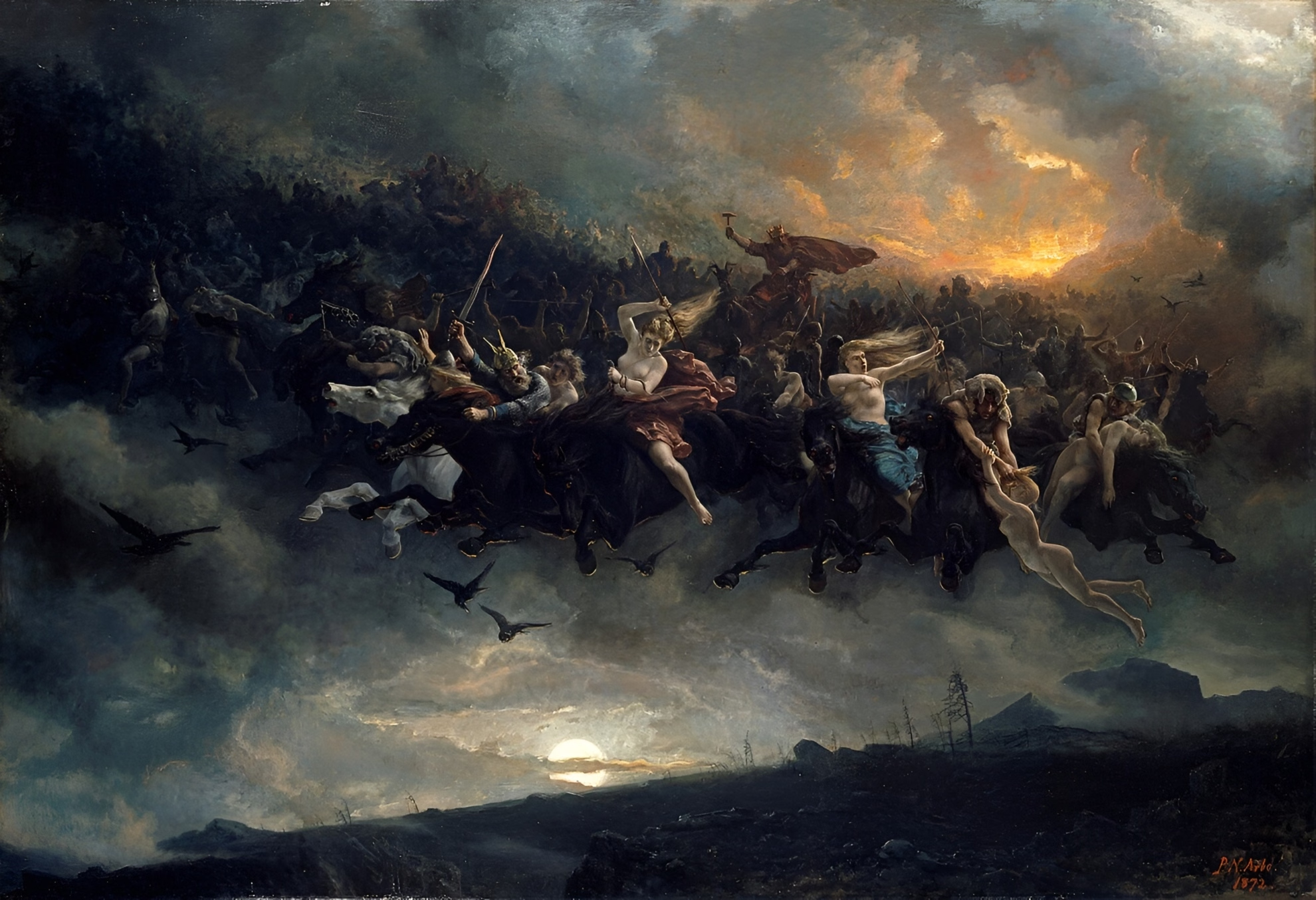
When the Nordic sound did emerge, it came from the same office and was packaged the same way. ‘Blood Fire Death,’ released by Black Mark Production in 1988, used as its front cover Peter Nicolai Arbo’s ‘Åsgårdsreien’ (‘The Wild Hunt of Odin’), a Norwegian painting from 1872, the same year Winge showed his ‘Thor’ in Stockholm.
‘Hammerheart’ (1990), widely treated as a founding Viking metal record, put Frank Dicksee’s ‘The Funeral of a Viking’ (1893) on its sleeve, credited to the Manchester City Art Gallery, and lists Boss Forsberg alongside Quorthon in its production credits.
There is a documented continuity, then, in personnel and in method. The producer who chose a nineteenth-century museum painting of a Norse god for a 1984 sampler of non-Nordic heavy metal remained in the production credits when his son developed a musical style to match such paintings. Bathory’s covers did not start a visual practice. They continued one that Tyfon had begun with a record on which Bathory appeared only because another band dropped out.
This changes the question of authorship. Asked who authored the “Nordic” identity that Viking and pagan metal later sold back to the world, the existing literature answers with musicians: Quorthon first, then Enslaved, Einherjer, Týr, and the folk metal bands that followed.
The 1984 record adds an earlier author: a small label that supplied the image before any musician supplied the sound, and that applied it to Finnish and Swedish bands alike, regardless of what they played. The musicians’ Nordic turn, when it came, filled a frame that had already been printed and sold across Europe.
Museum Walls to Record Racks
The paintings themselves point to the longer lineage. Winge’s ‘Thor’ and Arbo’s wild hunt both date from 1872, and both belong to the national-romantic painting of the Nordic countries in the decades when national identities there were being assembled from medieval and mythic sources.
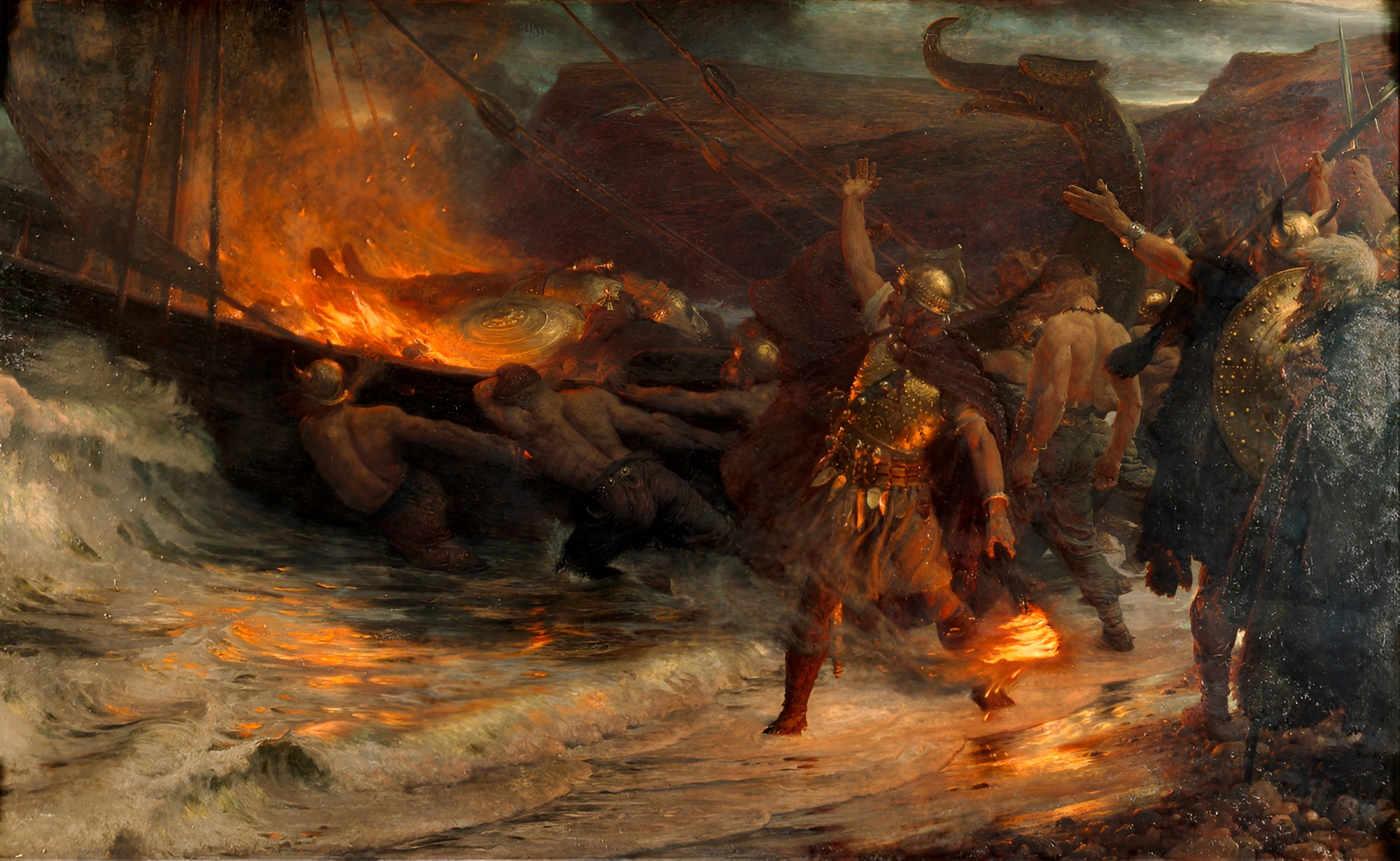
Dicksee’s ‘The Funeral of a Viking’ widens the frame further. It is an English Victorian canvas, signed and dated 1893 and set in a frame the artist designed with a running-chain ornament adapted from the Viking-age Borre style, and it has hung in Manchester since 1928.
The image that defines Viking metal’s founding album is British medievalism held in an English civic collection. What metal inherited, from 1984 onward, was the nineteenth century’s pan-European Romantic invention of the North, not a Scandinavian archive.
The Finnish parallel completes the pattern. Lönnrot’s ‘Kalevala’ was the same kind of national-romantic compilation, assembled from collected oral poetry into a national epic during the decades when Winge and Arbo were painting the Æsir. Finnish metal took up that material only in the 1990s: Amorphis based ‘Tales from the Thousand Lakes’ (1994) on the ‘Kalevala,’ and Karjalainen and Sipilä place that record at the turning point of Finnish metal’s international recognition.
In 1984, a decade earlier, the Finnish musicians on ‘Scandinavian Metal Attack’ appeared under a Swedish Thor, without any image of their own national romanticism. When Finnish metal adopted heritage imagery, it chose its own epic rather than the Swedish one it had been filed under.
The political dimension also belongs to this lineage, and the 1984 record clarifies it without settling it. The Nationalmuseum’s note that Winge’s ‘Thor’ has been read as nationalist imagery describes a reading the painting acquired after the nineteenth century, not one Tyfon intended. Hawkins and Pettipiece trace the same Thor imagery in Viking metal back to German Romanticism and the Völkisch movement.
The sampler shows that this vocabulary could enter metal with no ideological statement at all, as a label’s regional branding over songs about rock and roll and the devil. That casual entry is why the same symbols could later carry anything from nature worship to the racialized fantasies of heritage that scholars have documented in parts of the folk and pagan metal scene. The image entered metal as a marketing device and acquired its later meanings once it was there.
The Hammer Before the Riff
Read from the sleeve inward, ‘Scandinavian Metal Attack’ stops being a Bathory curiosity and becomes evidence of something the scholarship has placed four years too late and in the wrong hands.
In 1984 the North in metal was a picture, licensed from a national museum and chosen in a small Stockholm label office. It was attached to English-language heavy metal played mostly by Finnish musicians who were trying to sound like London and Los Angeles. The Viking sound that followed filled that picture rather than inventing it.
The correction does not diminish what Bathory did on ‘Blood Fire Death’ and ‘Hammerheart.’ It changes where the story of Nordic metal identity begins, and who has to be included in it. Oz, Trash, Spitfire, and Zero Nine are part of that history because they were the first music sold under the image. Their eight tracks are the record’s control sample: the sound of metal in the North before anyone decided that metal from the North had to sound like it.
If the Nordic image reached metal as packaging before it became music, how much of what you hear as “northern” in Viking and pagan metal today comes from the sound itself, and how much from the paintings that have framed it since 1984?
References
- Imke von Helden, ‘Scandinavian Metal Attack: The Power of Northern Europe in Extreme Metal,’ in ‘Heavy Fundametalisms: Music, Metal and Politics,’ ed. Rosemary Hill and Karl Spracklen (Oxford: Inter-Disciplinary Press, 2010), 33–41. ↩︎
- Simon Trafford and Aleks Pluskowski, ‘Antichrist Superstars: The Vikings in Hard Rock and Heavy Metal,’ in ‘Mass Market Medieval: Essays on the Middle Ages in Popular Culture,’ ed. David W. Marshall (Jefferson: McFarland, 2007), 57–73. ↩︎
- Simon Trafford, ‘Blood, Fire, Death: Bathory and the Birth of Viking Metal,’ in ‘Gathering of the Tribe: Music and Heavy Conscious Creation,’ ed. Mark Goodall (London: Headpress, 2013), 302–308. ↩︎
- Karl Spracklen, ‘‘To Holmgard… and Beyond’: Folk Metal Fantasies and Hegemonic White Masculinities,’ Metal Music Studies 1, no. 3 (2015): 359–377. ↩︎
- Shane Hawkins and Timothy Pettipiece, ‘Hammer of the Gods: The Heavy Metal Reception and Reforging of Thor,’ Metal Music Studies 10, no. 3 (2024): 217–232. ↩︎
- Annika Christensen, ‘Making Heritage Metal: Faroese Kvæði and Viking Metal,’ in ‘Medievalism and Metal Music Studies: Throwing Down the Gauntlet,’ ed. Ryan Barratt-Peacock and Ross Hagen (Leeds: Emerald Publishing, 2019), 107–119. ↩︎
- Toni-Matti Karjalainen and Eero Sipilä, ‘Tunes from the Land of the Thousand Lakes: Early Years of Internationalization in Finnish Heavy Metal,’ in ‘Global Metal Music and Culture: Current Directions in Metal Studies,’ ed. Andy R. Brown, Karl Spracklen, Keith Kahn-Harris, and Niall W. R. Scott (New York: Routledge, 2016), 209–226. ↩︎
- Toni-Matti Karjalainen, ‘Tales from the North and Beyond: Sounds of Origin as Narrative Discourses,’ in ‘Sounds of Origin in Heavy Metal Music,’ ed. Toni-Matti Karjalainen (Newcastle upon Tyne: Cambridge Scholars Publishing, 2018), 1–40. ↩︎
- Daniel Ekeroth, ‘Swedish Death Metal’ (Brooklyn: Bazillion Points, 2008), 30. ↩︎
Leave a Reply