

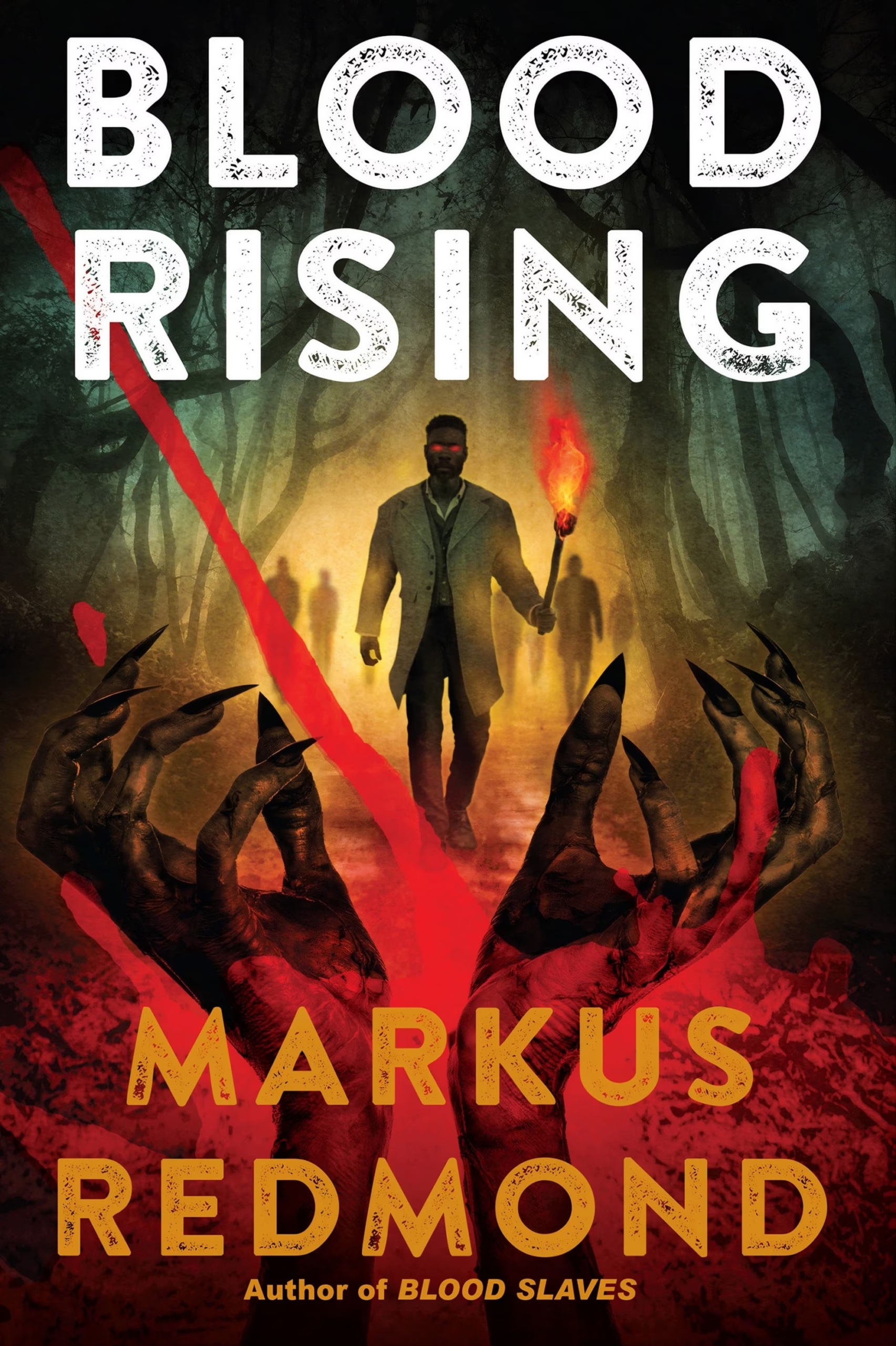
A vampire tribe that wins a plantation and then has to hold it is an unusual premise for a genre more accustomed to the hunt than the aftermath. Kensington Publishing’s Dafina imprint tests that premise across a full second volume when it publishes ‘Blood Rising’ on August 25th, 2026, a 432-page hardcover carrying the ISBN 978-1-4967-5319-9.
The novel continues the story Markus Redmond began the previous year in ‘Blood Slaves,’ the debut volume of an alternate-history vampire horror series Dafina has contracted as a three-book arc titled ‘The Blood Saga.’
Where ‘Blood Slaves’ worked from the position of the enslaved characters seeking freedom, ‘Blood Rising’ opens from the position of the newly free defending what they have taken.
Kwadzo Okoro, introduced in the first volume as a subject of the vampire Rafazi’s turning, now leads a reconstituted Ramanga Tribe occupying the renamed Crimson Plantation, a former site of bondage repurposed into shared ground for freed Africans and the Native communities that allied with them during the uprising.
The premise trades the first volume’s narrative of escape for one of defense, a structural shift that reorients the series from origin story to occupation.
From ‘Blood Slaves’ to ‘Blood Rising’
The ‘Blood Saga’ began in 2024, when Redmond signed a three-book agreement with Dafina, the Kensington Publishing imprint founded in 2000 to publish commercial fiction by and about people of African descent.
‘Blood Slaves,’ released July 29th, 2025, set its action on the fictional Barrow plantation in the Province of Carolina in 1710, where the enslaved laborer Willie accepts transformation from the vampire Rafazi in exchange for the means to free himself, Gertie, and the community around them.
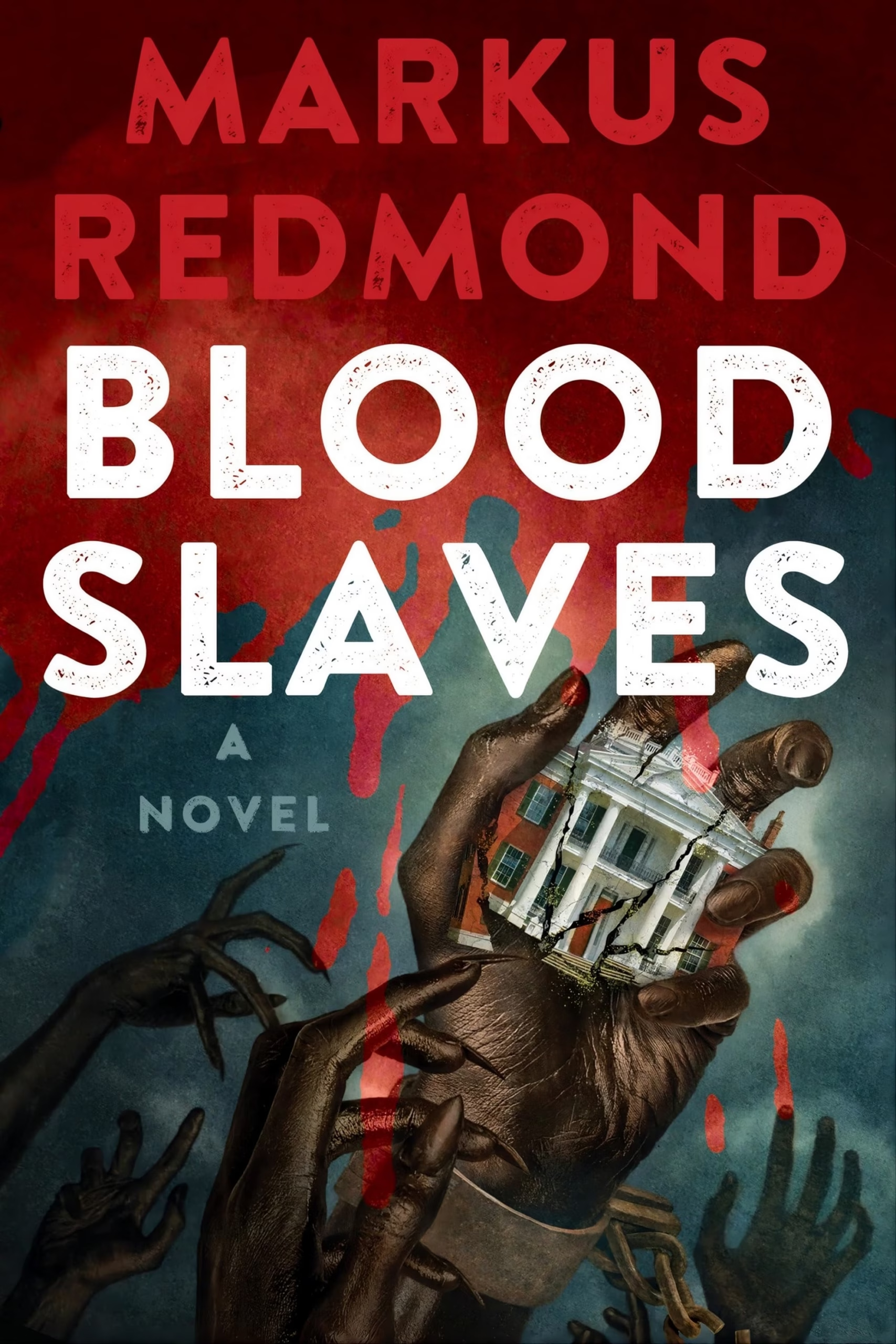
The novel functioned as an origin story for a mythology Redmond builds from scratch inside a documented historical setting, positioning the vampire not as predator upon the enslaved but as an instrument the enslaved take up against their captors.
‘Blood Rising’ picks up after that uprising succeeds. Bartholomew and Constance Crabtree, established in the confirmed synopsis as the region’s most influential slaveholders since the death of the first novel’s antagonist, James Barrow, work to organize the surrounding Lakeside community into an armed response.
A second antagonist, Penelope Knudsen, complicates that external threat by wielding Ramangan blood herself, granting her the sunlight tolerance the tribe’s own members lack and the capacity to raise a competing vampire force. The gravest threat, per the confirmed synopsis, originates inside the tribe itself: Rafazi, the vampire whose blood created Kwadzo and the rebellion both, resists his creation’s authority and strikes a deal with the Crabtrees that turns the maker against what he made.
The Betsileo Blood Servant
The name Redmond assigns his vampire lineage is not invented. Ramanga names a documented figure from the folklore of the Betsileo people of the southern Madagascar plateau, a servant attached to tribal chiefs and bound to consume the nail clippings and spilled blood of high-ranking individuals so that no witch could recover those materials for use in a fetish.1
The obligation was ceremonial rather than predatory in its original form, a role assigned to a living attendant rather than a description of an undead creature, and its documented function concerned the protection of royal remains rather than the pursuit of victims.
Redmond’s novel relocates that figure from Malagasy court ritual to the transatlantic slave trade, transforming a ceremonial blood-consumption role bound to noble protection into an origin myth for vampiric power seized by the enslaved. That transposition carries its own argument. Where the historical ramanga served the chief’s body to keep it from falling into hostile hands, Redmond’s Ramanga Tribe turns a comparable intimacy with blood into a weapon directed at the plantation system itself, converting a folk tradition organized around protecting the powerful into one organized around overturning them.
Beyond the European Bloodline
Vampire fiction in English has drawn its genre vocabulary almost entirely from a documented set of European sources: Polidori’s ‘The Vampyre’ in 1819, Le Fanu’s ‘Carmilla’ in 1872, and Stoker’s ‘Dracula’ in 1897 established the aristocratic, Eastern European-coded vampire that subsequent English-language fiction has returned to for two centuries.
African American vampire fiction that draws instead on African-sourced mythology remains, by documented scholarly account, a comparatively recent and still limited body of work, one that criticism has identified as departing from an inherited genre vocabulary built around a different continent’s folklore entirely.2
Jewelle Gomez’s ‘The Gilda Stories,’ Tananarive Due’s ‘My Soul to Keep,’ and Octavia Butler’s ‘Fledgling’ number among the small set of novels that scholarship has singled out for building black vampire mythology on grounds other than the Carpathian model Stoker fixed in the popular imagination.
‘Blood Rising’ extends that smaller lineage rather than the larger one. By keeping the Ramanga name and its Malagasy origin explicit across two novels rather than treating the African source as a onetime gesture, Redmond commits the series to a mythology that has to answer to its own folkloric record rather than to the conventions vampire fiction inherited from Stoker’s Transylvania.
A War on Two Fronts
The structure the confirmed synopsis describes commits ‘Blood Rising’ to managing three separate lines of pressure at once rather than the single antagonist that organized ‘Blood Slaves.’ The Crabtrees represent an external, human threat organized around the same plantation economy the first novel dismantled.
Knudsen represents a supernatural threat that mirrors Kwadzo’s own power while exceeding it, since her tolerance for sunlight removes the one documented limitation the Ramanga Tribe otherwise carries. Rafazi represents the most structurally dangerous threat of the three because it originates from inside the chain of command the tribe depends on, turning the maker-creation relationship that founded the rebellion into its central point of failure.
That triangulated pressure is a departure from the linear escape narrative of ‘Blood Slaves,’ which moved its central relationship toward a single, irreversible choice.
A sequel built around three converging threats rather than one asks its protagonist to defend a position on multiple fronts simultaneously, a structural choice that argues freedom, once won, produces its own new category of vulnerability rather than closing the story that produced it.
The Stage Behind the Page
Redmond’s route into fiction runs through three decades in front of and behind cameras rather than through prior published prose. His publisher biography credits roles across television including ‘Doogie Howser, M.D.,’ ‘NYPD Blue,’ ‘Murder One,’ and ‘Fight Club,’ a sold screenplay, ‘I Would Die for You,’ to Columbia Pictures, and writing, directing, and starring in the Amazon Prime feature ‘The 6th Degree.’ ‘Blood Slaves,’ released in 2025, was his first novel.
That screenwriting background carries an argument about the sequel’s likely construction even ahead of its release. A writer trained to build scenes around competing character objectives and to track multiple storylines toward a single confrontation, the discipline required by film and television structure, is positioned to manage the three-front conflict ‘Blood Rising’ promises across a single 432-page volume.
Whether that training produces a sequel that resolves its multiplying threats with the same clarity ‘Blood Slaves’ brought to its narrower stakes is a question the finished novel, not its screenwriting pedigree, will answer.
A Different War for the Same Freedom
What ‘Blood Rising’ proposes, on the terms of its confirmed synopsis, is that the end of one form of bondage does not close the account it opened. The Crimson Plantation stands as won ground rather than safe ground, and the novel’s three converging antagonists, an economic order still organizing itself to reverse the uprising, a rival power built from the same blood that founded the rebellion, and a maker unwilling to answer to his creation, together suggest that Redmond intends the sequel to interrogate what freedom costs to keep rather than simply what it costs to win.
Grounding that argument in the Ramanga’s Malagasy origin rather than in the genre’s standard European bloodline keeps the series answerable to a specific folkloric record most vampire fiction never consults.
Given how few vampire novels in English draw their central mythology from African rather than European folklore, does keeping the Ramanga tied to its Betsileo origin across two full volumes change what the series can argue about power and inheritance that a more loosely borrowed monster could not?
References
- Raymond K. Kent, ‘Early Kingdoms in Madagascar, 1500-1700’ (New York: Holt, Rinehart and Winston, 1970), 221. ↩︎
- Jerry Rafiki Jenkins, ‘The Paradox of Blackness in African American Vampire Fiction’ (Columbus: The Ohio State University Press, 2019), 1-14. ↩︎



Leave a Reply