


The dead of ancient Egypt could not speak until the living opened their mouths, and Amenhotep, a ritualistic black metal project from Carinthia, Austria, titles its debut album ‘Utterances for the Dead.’ The record comes out on December 4th, 2026, self-released, after two advance singles, ‘Utterance of Restoration,’ on October 9th, 2026, and ‘The Calling of Amentet,’ on November 13th, 2026.
The project’s own release page lists seven tracks and a limited CD edition, but it names no members, producer, recording studio, or engineers, and none could be confirmed elsewhere at the time of publication. That leaves the Egyptian material the record draws on, and the tradition it enters, as the ground on which a first account has to stand.
Speech Before the Tomb
More than 4,300 years ago, the walls of a king’s burial chamber at Saqqara carried writing for the first time. The Pyramid Texts, first inscribed in the pyramid of Unas in the late Fifth Dynasty, are the oldest surviving body of Egyptian religious writing, and they function as spoken ritual: spells recited for the dead king’s passage out of the tomb and into the company of the gods.1
Egyptologists number the spells as utterances, the same word that begins the title of Amenhotep’s debut. Two of them, Utterances 273 and 274, form the passage called the ‘Cannibal Hymn,’ also inscribed in the pyramid of Unas, in which the dead king devours the gods and takes their powers into himself.2
The spells are framed as speech. Many open with a formula that identifies them as words to be recited, and the corpus is arranged as a sequence of such recitations and not as a continuous narrative. The same spoken tradition carried forward into the Coffin Texts painted on Middle Kingdom coffins and later into the New Kingdom corpus the Egyptians called Coming Forth by Day, a title that reappears on the album’s tracklist.
No statement from the project links its record to the hymn, and none is implied here. The hymn matters because it shows how much the word utterance carried in the tradition that supplied it: speech was not commentary on the king’s fate but the instrument that produced it.
The Mouth and the Newborn
The Opening of the Mouth was the rite that returned the senses to the dead, performed on the mummy and on the statue that could house a spirit, so that it might breathe, eat, and speak. Ann Macy Roth has argued that its central act imitates the clearing of a newborn’s mouth with the little fingers, which makes the ritual a re-enactment of birth and childhood and not only a revival.3

The rite was a sequence of acts and not a single gesture: priests touched the mouth and eyes of the mummy or statue with ritual instruments, among them the blades named in Roth’s title, while reciting the liturgy that gave each act its words. ‘Utterance of Restoration’ is, by the project’s own description, based on that liturgy and set at the moment the deceased regains speech, breath, and movement.
According to its release page, the song’s lyrics turn on the breath returning from dust, the awakening of the ba, which Egyptian belief understood as the mobile aspect of a person, often drawn as a human-headed bird, and the passage through the western gate toward dawn.
In that reading the dead are not simply revived but born a second time, and the mouth is the first thing the living must open.
Amentet and the West
Amentet, whose name means She of the West, personifies the necropolises on the western bank of the Nile, where the sun sets and the dead were buried. Egyptian tradition depicts her wearing the hieroglyph for west on her head, and it gives her the task of receiving the newly dead into the western land. The dead were themselves sometimes called westerners, which shows how fully a direction had become a name for the afterlife.
The second single, ‘The Calling of Amentet,’ joins that goddess to an act of address. Jan Assmann’s study of Egyptian death rites devotes a section to the principle that a person lives only as long as the name is pronounced, which makes the voices of the living the means by which the dead survive and not merely a tribute to them.4
That is Egyptological context, offered to place the title, not a statement of what the song intends. The project’s own description is brief: it calls its music ritualistic black metal and names ancient Egyptian death rites as its subject, and it offers no further statement about the concept of the record.
The Singles and Their Titles
The titles of the two advance singles name their sources before a note sounds. ‘Utterance of Restoration’ names a single spoken act and the repair it performs, and ‘The Calling of Amentet’ names an invocation and its addressee.
Both titles position the record toward the spoken, ritual side of the Egyptian material, and the project’s own account of the first single confirms the direction: its release page describes the track as based on the Opening of the Mouth liturgy. The singles run 5:29 and 5:59, and the album opens with ‘The Calling of Amentet.’
The remaining credits follow the same pattern of absence. No producer or recording studio could be confirmed at the time of publication. The physical edition is a six-panel digipak CD, a limited first pressing of 300 copies that ships around the release date and is available to pre-order alongside a digital edition. Vinyl and cassette editions had not been announced at the time of publication.
The Passage the Titles Follow
The full tracklist extends the vocabulary beyond the two singles. ‘Scales of Ma’at’ names the weighing of the heart, in which the heart of the dead was set against the feather of Ma’at, the principle of truth and order, in the Hall of Two Truths, while the devourer Ammit waited to consume a heart that failed. ‘At the Breaking of the Akhet Gate’ names the horizon, the Egyptian word for the place where the sun rises and sets, which also names the season of the Nile’s flood.
‘Shu’s Lament – Echoes from the Red Land’ pairs the god of air, who in Egyptian cosmology holds the sky apart from the earth, with the Red Land, the desert margin that Egyptians set against the black soil of the Nile valley and where their tombs lay.
‘Chapter of Coming Forth by Day’ borrows the Egyptians’ own name for the corpus that modern readers call the ‘Book of the Dead,’ a New Kingdom body of spells that inherited material from the Pyramid Texts. ‘Ren Setep’ begins with ren, the Egyptian word for name, one of the elements that made up a person in Egyptian belief, which returns the record to the principle of the spoken name described above.
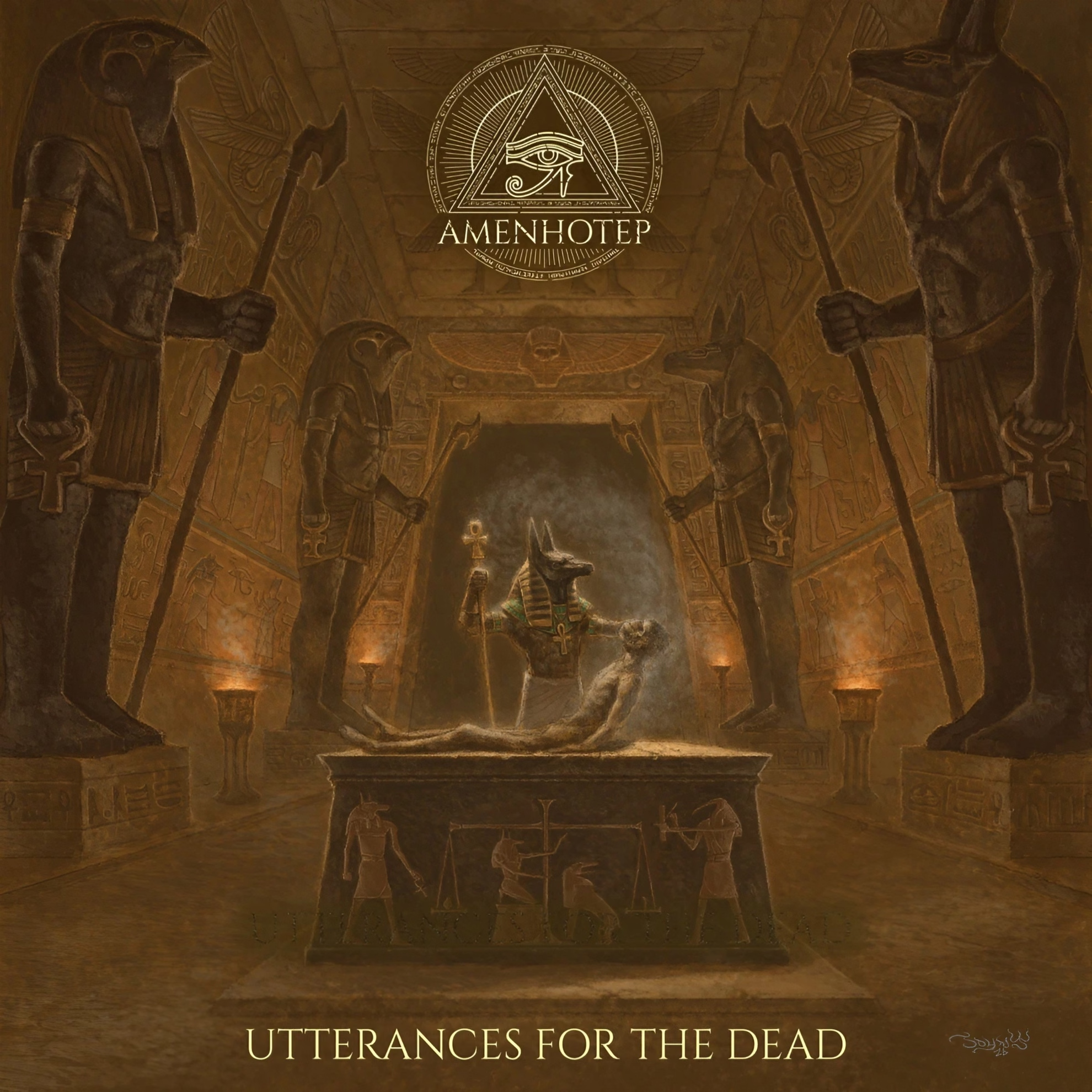
In listing order, the titles follow the course of a passage: reception in the west, restoration of speech and breath, judgment, the crossing of a horizon, and the return by day. That order is an inference from the titles and from the project’s own description of its first single as a pivotal transition within a funerary cycle, and no statement from the project confirms how the seven tracks are meant to be heard.
Carinthia and the Austrian Tradition
Carinthia is a southern Austrian province, and the national tradition the project emerges from includes the Austrian black metal of the nineties, which produced Summoning in Vienna in 1993. Summoning took Tolkien’s Middle-earth as the subject of most of its songs, and in doing so gave Austrian black metal a precedent for devotion to one closed textual world.
As a debut, the record has no preceding album to answer, and no earlier release by the project could be confirmed at the time of publication. The two singles are therefore the whole of the documented trajectory, and both titles belong to the vocabulary of address: one utterance, one calling.
An Egyptian Strand of Metal
Egyptian subject matter already has a documented place in extreme metal. The American death metal band Nile released ‘In Their Darkened Shrines’ through Relapse Records on August 20th, 2002, and its centerpiece, ‘Unas Slayer of the Gods,’ draws on the Cannibal Hymn in technical death metal.
That precedent matters to Amenhotep as a point of contrast, and Nile had already reached the rite that Amenhotep names.
Its 1998 debut, ‘Amongst the Catacombs of Nephren-Ka,’ includes a track titled ‘Opening of the Mouth,’ whose lyrics render the ritual as an act of force. Amenhotep’s first single, by the project’s own description, treats that liturgy as the moment of restored speech, breath, and movement, and its second title turns to the goddess who receives the dead.
A third Egyptian record sits on yet another axis. In this publication’s coverage of Shabti and ‘Haze, Cacophony, and White Light,’ the Portland, Maine trio turned the tomb-servant figures of the Middle Kingdom into a warning about successors, so that the labor of the dead, and not their speech, became the inheritance.
Tour markets and press coverage for Amenhotep could not be confirmed at the time of publication, so no assertion is made here about who the record reaches beyond Austria. What can be documented is the company it enters: a small, specific tradition in which Egyptian funerary texts have already been set to extreme metal, and in which the records so far have taken the corpus in different directions, toward the devouring hymn, the rite of the mouth, or the labor of the tomb servant.
The Names That Keep the Dead
The Egyptians spoke the names of their dead so that the dead would continue, and a debut from Carinthia, self-released on December 4th, 2026, carries a title drawn from the vocabulary of those spoken rites.
Its place has two sides. Within Austria, it follows a precedent for black metal devoted to one closed textual world. Beyond Austria, it enters an Egyptian strand of extreme metal in which records have drawn on the devouring hymn, the rite of the mouth, and the labor of the tomb servant, and the project describes its first single as based on the rite of speech. What the full record says remains unheard until it exists; the voice that opens the mouth is still to come.
When a metal record takes its vocabulary from rites meant to keep the dead alive through speech, which names would you want spoken, and what would it mean for a record to speak them?
References
- James P. Allen, ‘The Ancient Egyptian Pyramid Texts,’ 2nd ed. (Atlanta: SBL Press, 2015), 7–9. ↩︎
- Raymond O. Faulkner, ‘The Ancient Egyptian Pyramid Texts’ (Oxford: Clarendon Press, 1969), 80. ↩︎
- Ann Macy Roth, ‘Fingers, Stars, and the ‘’Opening of the Mouth’: The Nature and Function of the nTrwj-Blades,’ Journal of Egyptian Archaeology 79 (1993): 57–79. ↩︎
- Jan Assmann, ‘Death and Salvation in Ancient Egypt,’ trans. David Lorton (Ithaca: Cornell University Press, 2005), 41–52. ↩︎





Leave a Reply